Mostrar mensagens com a etiqueta Met. Mostrar todas as mensagens

quinta-feira, 20 de outubro de 2011

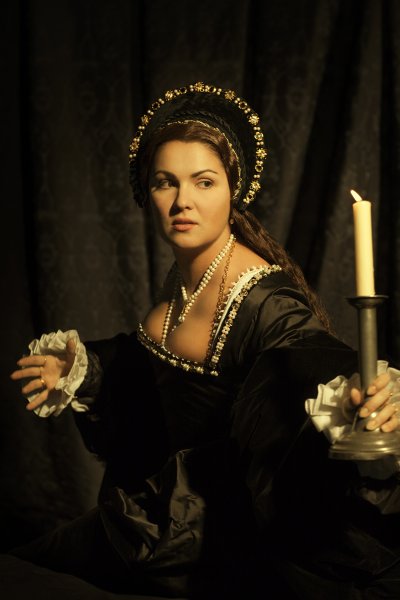
Anna Bolena – Met Opera House, récita de 15 de Outubro de 2011 (via F. C. Gulbenkian)


(Anna Netrebko, como protagonista de Anna Bolena: Met Opera House, Outubro de 2011)


Anna Bolena (1830) foi a ópera com que o jovem Donizetti - então com 33 anos - alcançou a glória. A mesma obra, juntamente com Maria Stuarda (de 1835) e Roberto Devereux (1837), forma a ilustre trilogia Tudor, uma das mais célebres da lírica.

Trata-se de uma ópera tipicamente bel cantista, com longas frases, ricamente ornamentadas e elaboradas, que demandam intérpretes ágeis, resistentes e detentores de uma veia lírica apuradíssima. Dada a grande exigência desta peça – sobretudo no tocante ao papel titular -, apenas em inícios do século XX assistimos à sua ressurreição. Não será por mero acaso que o Met jamais estreou esta obra!

De entre as mais distintas protagonistas de Anna Bolena, destacam-se Maria Callas – que a interpretou numa extraordinária produção, no alla Scala (1957), a partir de uma encenação luxuosíssima de Visconti -, Leyla Gencer e Joan Sutherland. Beverly Sills distinguiu-se de igual modo neste papel, tendo cometido a proeza de interpretar os restantes papeis titulares das duas outras obras que compõem a trilogia Tudor. Os mais interessados leitores encontrarão a trilogia encabeçada por Sills à venda… nas lojas on-line!


O libreto de Felice Romani sugere uma protagonista profundamente narcísica, absolutamente centrada na defesa da sua honra e orgulho. Anna não ama Henrique, nem de perto, nem de longe. Aliás, não sei se terá, alguma vez, amado alguém… Henrique constitui um apêndice fálico, que abre à Jovem Bolena o acesso à glória e poder. Para condimentar a protagonista, o libretista decide dotá-la de uma cena de loucura. As mad scenes eram imperativas, à época – vide I Puritani, Lucia di Lammermoor, Dinorah, Hamlet, etc.

O labor do encenador McVicar – profundamente simbólico – assenta numa concepção hiper-realista, elegante e faustosa (embora aqui e ali frugal) da obra. Os cenários (Jones) são imensos e grandiosos, de uma austeridade assinalável. No guarda-roupa (Tiramani) o luxo e exuberância transcendem-se.

McVicar joga, sobretudo, com as tonalidades, que definem estados de espírito e dimensões semi-ocultas dos personagens: cinza e preto traduzem o lúgubre e trágico; o leito real da rainha, escarlate, muito vivo, sugere uma Bolena algo pecaminosa…

No plano artístico e vocal, indubitavelmente, Anna Netrebko é magnânime, regina assoluta da récita. Compõe uma Bolena altaneira, orgulhosa, aterrorizada pela humilhação e vergonha. A voz, apoteótica, encontra-se absolutamente dominada. Pontualmente, haverá quebras no volume, mas o protagonismo e disciplina arrebatam. Sem sinais de fadiga, olimpicamente, Netrebko enforma em pathos as longas frases, iluminando as ornamentações assassinas da partitura. Termina, majestosa, com uma bravura memorável… Com 10 kg a menos, teria o universo a seus pés!

O restante elenco, apesar do elevado nível, apresenta fragilidades: Gubanova (Giovanna) é convincente, mas muito feia e tem um timbre grosseiro, Abdrazakov apresenta graves hesitantes, apesar da envergadura da sua caracterização, e Costello revela certa inconsistência na composição dramática, torneando com relativa habilidade as dificuldades técnicas que vai enfrentando.

Armiliato dirge rotineiramente a orquestra do Met, sem brilho particular.
Por Annuska, above all!

_________

* * * * *

(4/5)

quarta-feira, 28 de setembro de 2011

Anna Bolena: première no Met - 26 de Outubro de 2011


«To open the Met’s season, Ms. Netrebko sang the punishing title role of Donizetti’s “Anna Bolena” in the company’s first production of this breakthrough Donizetti work from 1830. The extended last scene was the high point of Ms. Netrebko’s performance as the distraught British queen (based on the historic Anne Boleyn, the second wife of Henry VIII). Having been falsely condemned for betraying her husband, Anna drifts in and out of sanity.

Ms. Netrebko sang an elegantly sad aria with lustrous warmth, aching vulnerability and floating high notes. When the audience broke into prolonged applause and bravos, Ms. Netrebko seemed to break character and smile a couple of times, though her look could have been taken as appropriate to the dramatic moment, since the delusional Anna is lost in reverie about happy days with her former lover.

Then, at the end of this “Mad Scene,” Anna, restored to horrific reality, curses the “wicked couple,” the king and his new queen, and stalks off to her execution, insisting implausibly that she is not seeking divine retribution but going to her grave with mercy on her lips. Ms. Netrebko dispatched Donizetti’s cabaletta, all fiery coloratura runs and vehement phrases, with a defiance that brought down the house.

Yet Ms. Netrebko’s Anna and the overall performance of the opera were not what they could have been. The production, by the director David McVicar, is uninventive and safe. The sets, by Robert Jones (in his Met debut), are handsome and efficient but tamely traditional, using a matrix of rotating white brick walls and sliding wood panels to evoke the interiors and environs of Henry’s palaces.

In Act I, when the king’s hunting party gathers, complete with two impressively large dogs, a bit of abstraction is introduced through some sculptural gray trees. Jenny Tiramani’s costumes are colorful, detailed and true to the period. Too true. This Henry could have come from the set of almost any of the innumerable films and television shows that have been made about the Tudors.

But the bigger problem was Marco Armiliato’s routine conducting. Mr. Armiliato has been valuable to the Met’s Italian repertory wing since his 1998 house debut. In “Anna Bolena” he conveyed an understanding of bel canto style, in which arching lines must be given room to spin and cast their spell, and accompaniment patterns have to be flexible.

The singers seemed to feel supported by Mr. Armiliato, who was always there when they took liberties. That was the problem. This performance needed a conductor to instill some intensity into the music, to keep the cast more on edge, especially in the early scenes. Much of the action occurs in highly charged bursts of dramatic recitative. But too often here the orchestra chords that buttress the vocal lines were listless. And the orchestra’s playing lacked character.

Previously, Ms. Netrebko had sung the role of Anna only at the Vienna State Opera this spring. She started tentatively on Monday, perhaps settling in for the long, hard night of singing that awaited her. She looked regal and splendid. And in a nice directorial touch, Anna first appeared with a little red-haired girl, clearly her daughter, the future Queen Elizabeth.

At 40, Ms. Netrebko may be in her vocal prime. Her sound is meltingly rich yet focused. Sustained tones have body and depth. Her contained vibrato exposed every slight slip from the center of a pitch, especially in midrange, but I’m not complaining. This remains a major voice, with resplendent colorings and built-in expressivity.

Bel canto purists have long debated whether Ms. Netrebko is a natural to the style, especially in her execution of coloratura passagework. She may not have the nimble precision exemplified by Beverly Sills (who was criticized by some for that very accuracy). Ms. Netrebko’s approach is to sing coloratura as a lyrical elaboration of the vocal line, which she did affectingly as Anna. And she exudes vocal charisma.

Still, at moments throughout the evening her singing seemed cautious. She was at her best when sparring with other singers, especially the mezzo-soprano Ekaterina Gubanova, who was Giovanna (the queen’s lady-in-waiting Jane Seymour, though it’s best to stick to the Italian names, since “Anna Bolena,” with a libretto by Felice Romani, plays very loose with history). Ms. Gubanova has an ample, dark voice with a slightly hard-edged quality that takes some adjusting to. She sang Giovanna with incisive delivery, folding embellishments and runs into impassioned vocal lines.

Her character was a bundle of nerves in Donizetti’s inspired Act II scene in which Giovanna finally confesses to the queen that she has been the king’s mistress and will become his new wife. Again the orchestra under Mr. Armiliato seemed to hold back, rather than empower, the intensity these two artists were trying to summon onstage.

The bass Ildar Abdrazakov brought his earthy, muscular voice to the role of Enrico (Henry VIII). Though his passagework was muffled by his gravelly tones at times, he was an imposing presence, and he did not overplay the king’s brutishness.

The tenor Stephen Costello won a hearty ovation for his Riccardo (Lord Percy, Anna’s former lover). This was a big assignment for the gifted and game young tenor. Mr. Costello captured the character’s consuming adoration for Anna through his impetuous and anguished singing.

The role includes a touchstone tenor aria, “Vivi tu,” in which the condemned Riccardo implores his friend Lord Rocheford (Anna’s brother, here the solid bass-baritone Keith Miller) to evade the king’s wrath and go on living. Mr. Costello mostly navigated the music’s demanding passagework and exposed high notes. To hear this rising artist stretching himself was part of the excitement.

The mezzo-soprano Tamara Mumford took on the trouser role of Mark Smeaton, a court musician with a fatal crush on Anna. Her singing was sometimes shaky but always honest and ardent. The able tenor Eduardo Valdes as the court official Hervey rounded out the cast. Every role is significant in an opera so rich with ensembles, including a climactic Act I sextet almost as memorable as the enduring sextet from Donizetti’s “Lucia di Lammermoor,” and more contrapuntally intricate.

Mr. Gelb has said that ideally the Met should make an artistic statement by presenting an ambitious new production every opening night. Two years ago he took a chance on Luc Bondy’s ill-conceived staging of Puccini’s “Tosca.” Last season came the premiere of Robert Lepage’s production of Wagner’s “Rheingold,” which is still being argued over, as audiences await the last two installments of the complete “Ring” cycle this season.

“Anna Bolena” represented a different sort of risk. To make a case for this great, overlooked opera, a company must have a stellar soprano in the title role. Ms. Netrebko is that artist. If only she and her colleagues onstage had received more help from Mr. McVicar and Mr. Armiliato.

The gala evening performance was relayed to Times Square and to Lincoln Center Plaza, where there was seating for some 3,000 people who had scooped up free tickets earlier. After the curtain calls onstage, the “Anna Bolena” cast appeared on the Met’s outdoor balcony to the cheers of the crowd. This is becoming a welcome tradition under Mr. Gelb


Ao que parece, a menina-dos-olhos de Peter Gelb - Netrebko - compôs uma Anna Bolena modelar. Brilhou como poucos. Da encenação, pouco haverá a enaltecer, dada a irresistível incursão de McVickar pelo pró-realismo... Armiliato também não se encontrava particularmente inspirado...


A 15 de Outubro, dir-vos-ei de minha justiça, com conhecimento de causa!

domingo, 24 de abril de 2011

Der Ring 2/4, ossia A Valquíria


(Voigt e Terfel em A Valquíria, Met, Abril de 2011)


Segundo round de O Anel, d’après Robert Lepage, em cena no Met!

Depois de um circense O Ouro do Reno, eis que Lepage estreia A Valquíria, primeira jornada de três, que compõem a tetralogia wagneriana – as derradeiras verão a luz do dia na próxima temporada da sala nova-iorquina.

Uma vez mas, o dispositivo cénico levantou dificuldades aos intérpretes, que se viram e desejaram para levar a carta a Garcia! A notícia do
The New York Times diz tudo: A ‘Walküre’ Still Obsessed With Its Big, Expensive Toy. Não é suposto, pois não?!

No tempo da outra senhora, a encenação servia a obra… Mas hoje em dia, a obra é crucificada diante do capricho narcísico do encenador!

Em todo o caso, o que merece destaque, na minha opinião – posto que se trata de uma récita lírica –, é a prestação da orquestra, maestro e intérpretes.

Quando, no mesmo palco, se reúnem bestas operáticas do calibre de Terfel (Wotan), Kaufmann (Siegmund), Voigt (Brünnhilde), Blythe (Fricka) e Westbroek (Sieglinde), dirigidas por um maestro oleado em Wagner como Jimmy Levine, o resultado só pode ser um estrondoso sucesso!

Lá para finais de Maio, por ocasião da minha derradeira deslocação a NYC (esta temporada), dir-vos-ei de minha justiça…

«Two scenes in the Metropolitan Opera’s highly anticipated new production of Wagner’s “Walküre,” which opened on Friday night, showcased what is both captivating and exasperating about Robert Lepage’s production, the second installment in his staging of the complete “Ring” cycle.


During the opening storm scene, the 24 movable planks of the imposing set by Carl Fillion that dominates the production (which the cast and crew call the machine) rose upright (with, as always, some audible creaking) to become a wall for video images of gusting, snow-flecked winds. Then the images and beams morphed into a forest of ominous gray trees through which you could see young Siegmund (the tenor Jonas Kaufmann), exhausted and injured, fleeing an avenging band of sword-wielding clansman as they searched for him with lanterns. It was an arresting realization of action depicted in the opera only in fitful orchestral music.


But a problematic staging touch came at the opening of Act II. Here the planks jutted out to evoke the “wild rocky place” that Wagner calls for. Wotan, the bass-baritone Bryn Terfel, came bounding onto the beams, now horizontal, which were alive with images of rocky terrain. Then his rambunctious daughter Brünnhilde, the soprano Deborah Voigt, appeared. As Ms. Voigt started to climb the planks that evoke the hillside, she lost her footing and slid to the floor.


Fortunately Mr. Lepage and the cast had correctly decided to play this scene for its humor. Brünnhilde, a warrior maiden who wants nothing to do with marital ties, has come to tease her father and alert him that his bossy wife, Fricka, is fast approaching. So Ms. Voigt rescued the moment by laughing at herself. She stayed put on the row of flat, fixed beams at the front of the stage and tossed off Brünnhilde’s “Hojotoho” cries.


The problem here was not just that in this crucial dramatic moment, with Ms. Voigt about to sing the first line of her first Brünnhilde, Mr. Lepage saddled her with a precarious stage maneuver. The problem was that for the rest of the scene, whenever Wotan or Brünnhilde walked atop the set, the beams wobbled and creaked. At times Mr. Terfel, a big, strong man, had to extend his arms to balance himself. No imagery is worth having to endure the sounds of creaking gears and looks of nervousness on the faces of singers.


What moved me about this “Walküre” and made the five-hour-plus evening seem to whisk by was the exciting, wondrously natural playing that James Levine drew from the great Met orchestra and the involving singing of the impressive cast. Mr. Levine has had a rough time recuperating from back surgery. His conducting on Friday, if not as commanding as his work in Berg’s “Wozzeck” this month, was inspired and beautiful. Certain passages were perhaps not as together as in Levine “Walküre” performances past. But this one had fresh urgency and sweep. Taking bows onstage at the end, with the supporting arms of Mr. Terfel and Ms. Voigt, he looked frail. Still, he did superb work and was greeted with a huge ovation.


Among the cast Ms. Voigt had the most at stake. A decade ago, when she owned the role of Sieglinde at the Met, she seemed destined to be a major Brünnhilde. Her voice has lost some warmth and richness in recent years. But the bright colorings and even the sometimes hard-edged sound of her voice today suits Brünnhilde’s music. I have seldom heard the role sung with such rhythmic accuracy and verbal clarity. From the start, with those go-for-broke cries of “Hojotoho,” she sang every note honestly. She invested energy, feeling and character in every phrase.


There were certainly some vocally patchy passages. Now that she is past this first performance, she may better realize her conception of the character, who evolves from a feisty tomboy to a baffled goddess deeply moved by Siegmund’s love for Sieglinde. All in all, this was a compelling and creditable Brünnhilde.


More than in the production of “Das Rheingold” that opened the season, Mr. Terfel’s stated intentions with Wotan came through here. He may not have the noble, sonorous voice of Wotans in the Hans Hotter lineage. But his muscular singing crackled with intensity, incisive diction and gravelly power.


During Wotan’s long narrative in Act II, in which he explains the whole sorry story of his life to Brünnhilde, many singers emphasize the despair of this broken god. Mr. Terfel ranted and raged as he relived the events.


The audience fell in love with the new Met Siegmund, Mr. Kaufmann, who proved his Wagnerian prowess last summer as Lohengrin at Bayreuth. Handsome and brooding, he captured all the valor and torment of this uprooted demigod. His dark, textured and virile voice has ideal Germanic colorings for the music. He is a true tenor, and the role may sit a little low for him. He could not wait, it seemed, to sing the big high A in Siegmund’s last phrase of Act I, which he held onto thrillingly. He had a great night.


Not so, unfortunately, the Dutch soprano Eva-Maria Westbroek, in her Met debut, as Sieglinde. Fresh from her triumph in the title role of Mark-Anthony Turnage’s new opera “Anna Nicole” at Covent Garden, Ms. Westbroek was eager to introduce herself to Met audiences in a Wagner role for which her big, gleaming voice is well suited. In Act I she looked lovely and sounded good if a little steely. Before Act II Peter Gelb, the Met’s general manager, announced from the stage that even though Ms. Westbroek was ill, she would sing anyway. But once the act got going, she decided not to appear, and Margaret Jane Wray, an experienced and dusky-voiced Wagnerian, sang that act and the next.


As Fricka, the mezzo-soprano Stephanie Blythe was in typically astonishing voice. This aggrieved goddess has just one crucial scene in the opera, a marital confrontation with Wotan in which she demands that Siegmund, having violated the covenants of marriage and engaged in incestuous love, must be allowed to die in his battle with Hunding (the stentorian bass Hans-Peter König). Mr. Lepage has Fricka play almost the entire scene sitting on an exotic throne that is rolled out a little shakily. But Ms. Blythe is such a compelling presence and formidable singer that she did not seem confined. Stephanie Blythe rules.


The stage effects in this production are sometimes amazing, sometimes clunky and intrusive. (And what was the persistent white-noise whirring that seemed to be coming from the ventilation fans in the boxes that house the video projection equipment?)


The long Act I encounter in which Siegmund arrives as a stranger at Hunding’s dwelling was played behind the extended apron of the set, back in a sunken portion of the stage. Why place this most intimate action so far back, where the voices were sometimes swallowed up? For most of the act the legs of the three singers were cut off from view — from the knees down. Left alone at night, Mr. Kaufmann’s Siegmund briefly leaped atop the extended apron, and here, suddenly, was the character in full, and much closer to us; Mr. Kaufmann looked liberated and sounded terrific.


During the “Ride of the Valkyries” Mr. Lepage had fun. The eight sisters straddled individual beams as if riding horses, holding reins and staying in place as the planks rose and fell to evoke the galloping steeds.


Still I do not understand Mr. Lepage’s devotion to using body oubles. In the final scene, some of the most sublime music ever written, Wotan places Brünnhilde in a sleeping state and leaves her atop a mountain surrounded with fire. But here Mr. Terfel led Ms. Voigt, in a trance, off the stage. The machine went into action, and soon we saw a body double as Brünnhilde hanging upside down on raked planks with images of rocky cliffs and spewing fire. We had, in effect, an aerial view of the mountain top.


But having bonded with Ms. Voigt’s Brünnhilde, I wanted to see the living, singing goddess meet her fate, with a much simpler staging. Mr. Lepage cannot help showing off his 45-ton toy, even when it means sending his Brünnhilde to the wings at what should be her most transcendent moment

quinta-feira, 7 de abril de 2011

Maricarmen


(Waltraud Meier)


Em 1996, no Met, depois de atingida a glória, Waltraud Meier arrisca novos terrenos… e dá-se mal, muito mal. A sua Carmen foi absolutamente aniquilada pela crítica – sobretudo -, que a descreveu como uma fria germânica, almejando a graça latina.

Meier sofreu muitíssimo como o duro revés. Mas, como diria o outro, são “ossos do ofício”.

Doravante, regressou ao Met, apenas, no seu elemento natural, ossia Wagner.


Pessoalmente, considero Meier uma extraordinária intérprete, com uma veia dramática memorável. Embora a voz brilhe, a consagração só se dá quando representa. E como brilha a sua Kundry – a melhor da sua geração -, Isolda, Fricka, Venus, and so on

Aos 55 anos, Meier regressa ao Met, desta feita para interpretar Marie, a protagonista feminina de Wozzeck (Berg).


O excelente artigo do The New York Times disseca a relação conturbada de Meier com o Met, quase sugerindo o que me parece óbvio: la vendetta! Depois do logro de Carmen, a Marie de Meier soa a um ajuste de contas com o público e crítica Metropolitanos. Oxalá!

É que – caro e fiel leitor -, ao seu jeito, Marie é também uma Carmen, ambas criaturas claramente afins com as vicissitudes da histeria…


Her first international appearance was in Buenos Aires in 1980, as Fricka in “Das Rheingold.” She made her debut at Bayreuth in 1983 as Kundry in Wagner’s “Parsifal,” her first time working with Mr. Levine. He became her Met champion, bringing her to the company in 1987 as Fricka in the premiere of the Otto Schenk production of Wagner’s “Ring” cycle. By the time she returned in the early 1990s, she had begun taking on traditional soprano roles like Isolde and Leonore in “Fidelio.” She had acclaimed runs at the Met as Kundry in 1992 and Santuzza in Mascagni’s “Cavalleria Rusticana” in 1993. She sang Sieglinde in the first act of “Die Walküre” with Mr. Domingo on the opening night of the 1993-94 season, and was a frequent soloist in concerts with Mr. Levine and the Met Orchestra.


It is in that context that Ms. Meier’s run in “Wozzeck” finds its meaning, both for the Met audience and for her, its undercurrent of poignancy and triumph. This is her moment finally to convince us, even to seduce us. “


segunda-feira, 28 de março de 2011

Lucia di Nuova York! (III) - 19 de Março de 2011, Met Opera House, via Fundação Calouste Gulbenkian

Dando cumprimento à promessa de há dias, eis a minha visão da Lucia di Lammermoor, em cena no Met.


Há um bom par de anos, Natalie Dessay estreou esta mesma produção, no Met. A noite de gala (já da era Gelb) foi por si encabeçada, com um brilho expectável. Desde então, as mais destacadas lirico-spinto da actualidade têm-na revisitado, destacando-se – sobretudo – a belíssima Netrebko e a graciosa Damrau.

Lucia di Lammermoor conta-nos a história da desventurada Lucia, personagem de uma fragilidade inusitada, que faz uma descompensação psicótica, diante de uma adversidade, evoluindo numa linha que se adivinha esquizofrénica. A trama, em certo sentido, recria a fórmula Shakespeareana (vide Romeu e Julieta) dos amores interditos, por se encontrarem inscritos num clima de rivalidade familiar. De permeio, deparamos com uma figura eminentemente perversa, interesseira e calculista – Enrico, o irmão de Lucia -, cuja malícia dita o desenlace trágico da obra.

A encenação de Mary Zimmerman conserva inúmeros pontos de interesse, particularmente pela circunstância de ilustrar o espírito lúgubre e dramático, característicos da obra de Walter Scott e (da lírica visão) de Donizetti. A fina mão da encenadora – por demais versátil (vide Armida) – propõe-nos um ambiente plenamente romântico, impregnado de tragédia e perda. Os figurinos (Mara Blumenfeld) são elegantíssimos, os cenários majestosos (Daniel Ostling), sem resvalarem para o realismo megalómano e pindérico de Zeffirelli! – e a iluminação (T. J. Gerckens) de uma notável eficácia, particularmente na construção dos ambientes intimistas, bem como na precisão com que ilustra o trágico.

Dos solistas destacam-se, particularmente, as prestações superlativas de Dessay e Calleja, respectivamente Lucia e Edgardo. Dessay terá perdido parte da sua pretérita agilidade. Os sobre-agudos enfermam de falta de espontaneidade e segurança, sem margem para dúvida. Contudo, a faceta soubrette da solista progrediu, no sentido lirico-spinto, aliando agilidade vocal a maior robustez. A Lucia de Dessay é um produto dramático, impregnado de pathos – atente-se no riso dissociado (e demais sinais de discordância, tão eficazmente ilustrativos da fractura psicótica) e na autenticidade da aparatosa queda (escadaria abaixo). Calleja, por seu lado, reabilita o estilo memorável de Di Stefano – o meu Edgardo discográfico: à segurança e ousadia técnica alia um sentido lírico arrebatador, patente na paixão com que ilustra a sua falta de fortuna. Absolutamente pungente!

Os demais solistas revelaram brilho e linhagem, sobretudo Tézier (Enriço) e Youn (Raimondo), maugrado a falta de envergadura teatral do barítono francês que, no plano vocal, foi irrepreensível!

Por fim, a fabulosa orquestra do Met fez jus à sua fama, proporcionando uma performance rica, pela coesão e sentido dramático revelados
________
* * * * *
(4,5/5)

sábado, 19 de março de 2011

Lucia di Nuova York!


Nat Dessay - a minha querida Nat - interpreta hoje, no Met, um dos seus papéis de eleição.

Hoje com ontem, a pretensa nobreza & burguesia pindérica - afectada pelas correntes aéreas da Porcalhota, quiçá - desdenha os (as, no caso) grandes!

Nos idos anos 1950 - em meados, sejamos precisos -, chic era menosprezar a Callas. Agora, é ver as palavras do sabichão Calado, no Expresso. Segundo o Calado-mor, salva-se a interpretação cénica, pois a voz é uma amostra do que era.

Mais tarde, democraticamente, veremos!

quinta-feira, 24 de fevereiro de 2011

quarta-feira, 16 de fevereiro de 2011

Met 2010 / 2011


O mundo lírico anda a reboque do Met, desde há décadas. Não há volta a dar!
Eis o soberbo programa da próxima temporada do Met Opera House, a que nenhum teatro lírico chega aos calcanhares!

ps só para que conste, Elisabete Matos - a GRANDE - alterna o papel de Abigaíl com a insuportável Guleghina, que há anos devia ter pedido a reforma antecipada! Mais? A temporada abre com Anna Bolena... interpretada por Netrebko! WHAT ELSE?

QUEM FOI QUE DISSE QUE NÃO VOLTAVA A NYC NOS PRÓXIMOS 3 ANOS?????

domingo, 2 de janeiro de 2011

La Traviata @ the Met


(La Traviata - Met Opera House, Dezembro de 2010)

Esta encenação de La Traviata foi estreada em Salzburgo, em 2005. Anna Netrebko interpretou uma Violetta absolutamente extraordinária, capaz de rivalizar com a da Callas. Onde a da grega era sofrida e vítima, a da Russa foi lasciva e lânguida.

À época em que tomei contacto com a Violetta de Netrebko, ensandeci. Contudo, a minha loucura passageira não invadiu a minha capacidade critica! Como referi, conheço dezenas de Violetta, sendo que duas sobressaem: a da Callas e a de Netrebko. Sim, eu sei, a da Cotrubas era muito lírica, como a da Gheorghiu; a da Sutherland (a primeira) era pirotécnica, como a da Caballé, etc. Mas, reitero: há duas imensas!

Peter Gelb, que limpa a poeira e o bafio do seu Met, decidiu – e bem – destronar a encenação de Zeffirelli. Por uma única vez, devo saltar em defesa do insuportável italiano... Assisti, em Abril de 2010, no Met, à sua proposta e não me desagradou, apesar da megalomania e hiper-realismo costumeiros. Já a sua Tosca merecia ter sido destruída, logo após a primeira récita!

Enfim, Gelb recuperou a mise-en-scène de Salzburgo (de Willy Decker) e eis o resultado...

«Even die-hard fans of the director Franco Zeffirelli’s productions for the Metropolitan Opera have to concede that his 1998 staging of Verdi’s “Traviata” was terrible. With its opulently garish sets and knee-jerk realism, the production dwarfed the cast, no matter what stars were singing. So the time has long since come for something different. And the intriguing production by the German director Willy Decker that the Met introduced on New Year’s Eve could not be more different.

The entire story is played within the confines of a tall, curved grayish-white wall, as if the action were taking place in an arena under clinically bright lights. And during crucial scenes groups of choristers lean over the wall like voyeurs, watching the deteriorating relationship between the dying, defiant courtesan Violetta and her smitten lover Alfredo, here played by the glamorous Russian soprano Marina Poplavskaya and the sweet-voiced American tenor Matthew Polenzani.

The costumes are modern. Violetta appears at the party in the opening scene in a short blazing red dress, and all the guests, male and female choristers alike, wear black tuxedos, making the crowd look androgynous and threatening. This “Traviata,” which originated at theSalzburg Festival in 2005 and was the hottest ticket of that summer, lives on as a popular DVD starring Anna Netrebkoand Rolando Villazón.

No doubt many opera buffs will dismiss it as just another high-concept Eurotrash outrage, though there was surprisingly little booing when Mr. Decker and the production team, in their Met debuts, took curtain calls on Friday night. This was in contrast to the opening night of last season, when the Met’s general manager, Peter Gelb, replaced the popular Zeffirelli “Tosca” with Luc Bondy’s gratuitously modern and lame staging.

In some scenes Mr. Decker’s reconceptions of “La Traviata” are as heavy-handed as the melodramatic clichés he abhors in traditional productions. And though the look here is bare and timelessly modern, the symbolism is forced, especially the ever-present giant clock to indicate the passage of time and the ticking-away of the terminally ill Violetta’s life.

Still, this is an involving and theatrically daring production that belongs at the Met. And unlike the suffocating Zeffirelli staging it replaces, it is a showcase for courageous singers. Mr. Decker clearly worked with his leads here to develop vulnerable, revealing portrayals.

With her long blond hair, slender physique and square-jawed face, the lovely Ms. Poplavskaya looks like a young Meryl Streep and exudes charisma. In traditional productions Violetta’s popularity with the Parisian set can give a false impression. She flouts societal codes, and Ms. Poplavskaya’s portrayal restores the character’s danger. There is something seedy about the opening party scene, when the guests lift up the red leather couch on which Violetta blithely strides, having kicked off her high heels.

Like many sopranos who have taken on this demanding role Ms. Poplavskaya, so splendid as Elisabeth in the Met’s recent production of Verdi’s “Don Carlo,” was less comfortable vocally in the coloratura flights of Act I than in the lyrical effusions and dramatic outbursts of the later scenes. She handled the runs of “Sempre libera” ably but was at her best earlier in this great solo scene, when, curled into a fetal position on the couch, she sang the rueful, aching phrases of “Ah, fors’è lui.”

From Act II through Act III Mr. Decker’s staging moves without a break. This forward momentum makes Violetta’s downfall and death dramatically inexorable but places enormous vocal burdens on Ms. Poplavskaya. In her farewell to dreams of a happy life with Alfredo, “Addio, del passato,” she sounded tired and took what seemed extra breaths where she could find them in the phrases. Still, her voice had a cool, earthy beauty; her sound was penetrating and vibrant. Even when fatigued, she floated some beautiful high pianissimo notes.

Mr. Polenzani, a fine lyric tenor, was an uncommonly elegant Alfredo. His sound, though not large, carried well, and the integrity and supple phrasing of his singing were special. That he looked so youthful and wholesome gave a startling charge to the moments in which Alfredo can barely contain his passion for Violetta. It was clear what keeps this reckless relationship going.

And after Alfredo’s father, Germont (the Polish baritone Andrzej Dobber, who had an imposing presence but sang with a leathery sound), persuades Violetta to give up Alfredo for the sake of the Germont family honor, the father-son confrontation was viscerally staged. Germont literally slapped sense into his son, which sent Mr. Polenzani to the floor, seething with humiliation and anger.

Sometimes Mr. Decker goes too far in exposing what he sees as the subtext of the opera. For example, Act II, as written, opens in a country house near Paris, where Alfredo and Violetta have been living for three months. Fresh from a hunt, Alfredo sings about how joyless life is when Violetta is away, then expresses his ardor in the aria “De’ miei bollenti spiriti.”

In this staging Alfredo is not alone but romantically entwined with Violetta, as they roll off a couch (one of five), she in a slip, he in his underwear, both loosely wearing flower-patterned bathrobes that match the fabric draped over the couches. The clock is also draped to show that for a while, at least, time has stopped for the lovers.

Even as Alfredo sings about how he misses Violetta, we see them playing a lover’s game of hide and seek among the couches. And during his aria, as Alfredo recalls the day Violetta declared her faithfulness and love, when Mr. Polenzani’s voice sent this romantic phrase soaring, Ms. Poplavskaya pretended to be singing along with sweeping arm gestures and fake-operatic intensity.

Is Violetta mocking Alfredo for his overheated feelings? What Mr. Decker means to come through, I think, is that Alfredo and Violetta are almost afraid to acknowledge the implications of their emotions, since she is clearly ill. So she mimics him to defuse his sincerity.

You really have to go with the concept to interpret the staging touch this way. I mostly did and found it fascinating. Still, some in the audience laughed as Ms. Poplavskaya imitated her lover. This is a big price to pay to lend a traditionally romantic Verdi aria a modern psychological twist.

Though the conductor Gianandrea Noseda led a performance that balanced passion with refinement, there were many moments of inexact coordination with the singers. The problem may have been that Mr. Decker was asking for the operatic equivalent of Method acting from his cast, and that the singers were too absorbed in their performances to pay close attention to the conductor.

This production is part of Mr. Gelb’s campaign to make the Met more theatrically innovative. He deserves credit for taking risks with the bread-and-butter staples of the repertory. The question is whether the Decker “Traviata” is the kind of reconceived production that will last for seasons into the future. Perhaps the Met will become a house where productions are rotated more often, which would be an interesting departure, though an expensive one.»

sexta-feira, 31 de dezembro de 2010

Marina Poplavskaya


(Marina Poplavskaya, como Elisabeth, em Don Carlo)

O The New York Times - que não é exactamente um jornal de deslumbrados - consagra um extenso artigo a Marina Poplavskaya, a derradeira Elisabete do Met.

Como referi, por ocasião da minha apreciação da récita, este soprano não me levou por aí além, mas - caro e fiel leitor -, no trecho Tu che le vanità, tivemos Mulher!

É muito chic desdenhar estes talentos, ditos meteóricos. Nos anos 1950 - nos inícios da década, note-se! -, em meios mais snob, havia um ar de enfado quando se falava d'A Grega... Há uns bons anitos, a Netrebko era uma "boazuda que cantava umas coisitas, e pouco mais". Eu próprio já embarquei nestas tiradas, está bem de ver!

O que importa - creio - é saber dar a mão à palmatória, reconhecendo a mestria das criaturas que se destacam.

Agora, honestamente, apontem-me dez Poplavskayas!? Eu conheço muito poucas... Esta, por enquanto, é para manter debaixo de olho... É que a última que desdenhei tornou-se - para mim e para o mundo - num monumento!

Quem desdenha...


«“The world dreams of seeing a real-life Cinderella,” Ms. Poplavskaya (pronounced puh-PLAHV-sky-uh) said in a recent interview backstage at the Met. “They hope you were washing floors when Luciano Pavarotti came by, and then a miracle happened.” If her onstage persona is opaque but impulsive, her conversation seems tinged with a very Russian fatalism, disillusionment and sense of the absurd, sometimes bone dry, sometimes contemptuous, sometimes wildly amused.

Her double-header as the Met’s reigning pinch hitter began last month in “Don Carlo,” originally directed by Nicholas Hytner two years ago at Covent Garden in London. Angela Gheorghiu had been expected as Elisabeth of Valois, a pawn in the dynastic politics of France and Spain. But late in the game she withdrew, deeming the part a poor match for her voice.

The plum fell to Ms. Poplavskaya, who accompanied the show to New York. In his review of “Don Carlo” for The New York Times, Anthony Tommasini noted that hers was not a “classic Verdi voice.” Yet he praised her “luminous singing, beautiful pianissimo high notes and unforced power,” adding, “Somehow the cool Russian colorings of her voice brought out the apartness of the character, a young woman in a loveless marriage in a foreign land.”

For her encore Ms. Poplavskaya now assays the prima donna’s Mount Everest: Violetta Valéry, the consumptive Parisian courtesan redeemed by love in “La Traviata.” Conceived at the Salzburg Festival five years ago as a vehicle for Anna Netrebko and Rolando Villazón, whose chemistry was then at its most sizzling, the production was a triumph in the flesh and on DVD. Ms. Netrebko, in particular, riveted all eyes and ears, the epitome of star-crossed glamour in her black bob and sick-rose-red cocktail dress. For Salzburg scalpers, it was a windfall, with black-market tickets changing hands for thousands of euros.

Would the production by the German director Willy Decker work in America? There was room for doubt. Mr. Decker confines the action to a bare chalk-white arena dominated by an oversize Swiss railway clock, peppering his take on Verdi’s Paris with distasteful Teutonic touches like kewpie doll Violetta masks for a hostile chorus and a leering Popeye lookalike (yes, male) in a knockoff of Violetta’s red dress. Still, who could blame the Met for wanting to recapture the sensation? So the Salzburg “Traviata” was duly booked forNew Year’s Eve 2010. Since the production was announced, Mr. Villazón, plagued by persistent vocal malaise, has vanished from the lineup. Worse, Ms. Netrebko, 39, dropped out, leery of competing with the ghost of her younger self on DVD.

So the Met wrangled Ms. Poplavskaya, who in the meantime has scored a big hit with the Decker “Traviata” in Amsterdam, taking home the artist-of-the-year award from the Society of Friends of the Netherlands Opera.

Unlike her American counterparts, who like to insist on the power invested in the abused women they so often portray, Ms. Poplavskaya sees the world through the prism of a people who have lived through one crushing regime after another: “I’m always a victim, torn between a mad tenor and a crazy baritone,” she said. “But not only sopranos are victims. In life we all are victims.”

If this is your point of view, one answer is to expect nothing, take your lumps and keep grabbing your chances, as Ms. Poplavskaya seems to have a genius for doing. When the crown that a colleague in a recent Met “Don Carlo” had to place on her head settled at an angle, she simply straightened it. “I’m a daughter of Catherine de Medici,” Ms. Poplavskaya said merrily when reminded of the incident. “She taught me well to keep the crown on my head, not off. If someone puts it on crooked, I must crown myself. I’m ready for anything.”

It seems it was ever thus. A headstrong 9-year-old, Ms. Poplavskaya presented herself unescorted at an audition for the children’s chorus at the Bolshoi Theater and made the cut. Her grown-up career began at the New Opera Theater in Moscow, as Tatyana, the impulsive provincial of Tchaikovsky’s “Eugene Onegin” who grows up to become a wiser but sadder princess in St. Petersburg high society.

Returning to the Bolshoi Ms. Poplavskaya took on an eclectic repertory that included, in English, Stravinsky’s light, lyric Anne Trulove in “The Rake’s Progress” and, in German, Wagner’s gale-force Senta in “The Flying Dutchman.” Seeking broader exposure she presented herself at the Academy of Young Singers at the rival Mariinsky Theater, in St. Petersburg, but the audition she hoped for with the company’s general and artistic director, Valery Gergiev — an international star-maker — never came about.

“They always told me he was very busy,” Ms. Poplavskaya said. “I only survived at the Mariinsky a few months. The only reason I came to St. Petersburg was to sing for Gergiev. But if I had, nothing else would have turned out as it did.”

Overqualified as she was, she gained entry to the young-artists program of the Royal Opera Covent Garden. The company promptly put her on the main stage as the Third Norn in Wagner’s six-hour “Götterdämmerung,” a part that clocks in at perhaps six minutes. Then things started happening.

It was around that time that Ms. Gheorghiu reconsidered “Don Carlo” and that Ms. Poplavskaya at last got to sing for Mr. Gergiev, at the Met, while rehearsing for her house debut as Natasha Rostova in Prokofiev’s “War and Peace” in December 2007. Though originally assigned to the second cast, she was bumped up to first.

Adding octane to Ms. Poplavskaya’s ascent The New Yorker has just published a profile of her under the title “Travels With a Diva,” by Gay Talese. His account begins with a naked, feverish Ms. Poplavskaya lying motionless on the floor of her mother’s Moscow apartment, felled by heat prostration and smoke inhalation. (After the article was published she told me that she had actually suffered a heart attack.) Thousands of words later, after vignettes worthy of a latter-day Dostoevsky — Ms. Poplavskaya ferrying a luggage cart across 22 lanes of Buenos Aires traffic, Ms. Poplavskaya carefully handing a stunned maître d’ two flies captured in an empty glass — Mr. Talese signed off with the image of the five-inch, red patent-leather pumps she will wear on New Year’s Eve as Violetta.»