Mostrar mensagens com a etiqueta Wagner (Wolfgang). Mostrar todas as mensagens

segunda-feira, 9 de agosto de 2010

Bayreuth IV - (ainda o) Lohengrin (de Neuenfels)


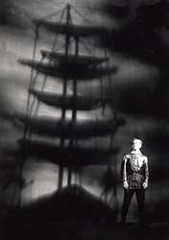
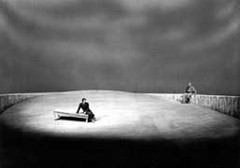
(Lohengrin, Bayreuth, 2010. Kaufmann, em primeiro plano - foto de cima - e demais elenco)

Nestas coisas de criticar encenações, todos ganhamos com o olhar ponderado, distante, sensível e avesso a preconceitos (e sobrancerias) dos
americanos. Esta notável leitura da nova produção de Lohengrin de Bayreuth, cuja polémica mise-en-scène de Neuenfelts tem gerado tanto mal-estar, coloca a coisa no seu lugar: há incongruências múltiplas no trabalho do encenador, a par de uma indiscutível riqueza simbólica.

Há muito que
Bayreuth se tornou num espaço de ousadia – por vezes decrépita. Recordar-se-á o leitor, ainda, do Parsifal de Herheim???

Quem procura consensos e encenações comme il faut, pode bem lambuzar-se com as poeirentas propostas de Zeffirelli!

Não sendo eu um fã de
Mortier – tido com o derradeiro vanguardista -, partilho da ousadia que introduziu em
Salzburgo. Agora é a vez de Bayreuth… pós W. Wagner!

«
BAYREUTH, Germany — It has become practically a part of the tradition at the Bayreuth Festival for the director of an avant-garde Wagner production to be vociferously booed on opening night. So it was on July 25, when the festival opened with the new Hans Neuenfels production of “Lohengrin,” which I saw here on Tuesday, the second performance.

If regie-opera (productions driven by a director with an imposing agenda) has a ringleader, it is probably Mr. Neuenfels, especially notorious for a 2001 “Fledermaus” at the Salzburg Festival that turned this frothy, waltzing comedy into a festering exposé of kinky sex and proto-Nazism.

What is mostly inciting the ire over Mr. Neuenfels’s “Lohengrin,” with sets and costumes by Reinhard von der Thannen, is his depiction of the nobles and commoners of 10th-century Brabant as rats in a sterile modern-day laboratory. Only the main characters — the Christian knight Lohengrin, the fair lady Elsa, King Henry the Fowler of Germany, the conniving Count Friedrich von Telramund and his wife, Ortrud, who practices the occult — are presented as fully human and, consequently, superior.

The concept is laden with symbolism, and Mr. Neuenfels’s presence as a director-commentator pervaded every scene. Yet provocative and insightful ideas fire this intriguing staging. And, as always at Bayreuth, the production values are so high that every set, costume and prop looked great.

What mattered most, of course, was the overall, and exceptionally strong, musical performance. In his debut role at Bayreuth, the German tenor Jonas Kaufmann was a magnificent Lohengrin. He looked the part of an earnest, pensive and dazzling young knight, come to defend Elsa against falsehoods and marry her. The fast-rising 31-year-old Latvian conductor Andris Nelsons, the music director of the City of Birmingham Symphony Orchestra in England, also making his Bayreuth debut, drew a glowing, supple and richly detailed performance from the festival orchestra. During the prelude to Act I, the penetrating warmth of the soft strings in this acoustically miraculous house, designed by Wagner, was spellbinding.

In an interview for the program book Mr. Neuenfels says that Wagner’s music “thinks, and thinks grandly,” that this is music of “concepts.” The question is whether the music should be allowed to convey its concepts free of a director’s explicit ideological imagery.

During the prelude the house lights went up to reveal a white-walled room with metallic gates to the sides and a rear wall with eerie portals poking through. Mr. Kaufmann’s Lohengrin, his back to the audience, looking Christlike with his arms spread, put his shoulders to the task and slowly pushed the back wall into the rear of the stage: an effective and richly metaphorical touch.

But in the first scene, when King Henry, recruiting troops to fight the Hungarians in the east, calls an assembly of noblemen and the people of Brabant, the chorus appears dressed in gray, loose-fitting rat costumes, complete with long tails, floppy feet and see-through head masks, red eyes aglow.

We get it. The commoners and even the nobles are trapped in a society in which they have circumscribed roles to play and are used by the powerful. But could the same not be said of, say, Telramund, who is manipulated by his consort, Ortrud, or even, in a way, King Henry?

Elsa relates a dream she has had in which God sends a white knight to defend her. When that savior, Lohengrin, appears to rescue her from charges that she has murdered her noble brother, and a trial commences, the choristers remove their rat frocks for the duration of the scene. Men and women alike wear rich yellow suits and matching hats. So there are times when they are allowed to transcend their rat roles? I was not sure, though the choristers certainly looked wondrous in their striking yellow garments.

Still, fine music making drove this rich evening of Wagner. Mr. Kaufmann earned many fans at the Metropolitan Opera this spring with a one-two punch triumph: singing Cavaradossi in the new production of “Tosca” and Don José in the new production of “Carmen.” On Tuesday in Bayreuth he did not sound in his very best voice. Some pianissimo phrases were breathy, and he lacked a little of his trademark burnished power. Overall, though, he sang splendidly, with soaring phrases and earthy vocal colorings. His singing is an ideal balance of keen intelligence and vocal charisma.

When we first see the soprano Annette Dasch as Elsa, she is in a shining white coat pierced with arrows representing the false accusations that have been shot at her. Lohengrin plucks away the arrows. But Ms. Dasch conveyed Elsa’s wounded dignity so naturally that she did not need this lamely obvious metaphor. She was a touching Elsa who sang with warmth and pliant phrasing, but for a few strained high notes during some of the impassioned outbursts.

The soprano Evelyn Herlitzius brought hard-edged, sometimes wobbly vocal intensity to her vehement portrayal of Ortrud. The role need not be sung with such continuous ferocity. Still, Ms. Herlitzius was a maniacal force as Ortrud, and her top notes shook the house. The veteran Wagnerian baritone Hans-Joachim Ketelsen was a grave and fitful Telramund. The bass Georg Zeppenfeld as King Henry and the bass-baritone Samuel Youn as the Herald were excellent.

By Act III Mr. Neuenfels had worn down my resistance. As the citizens of Brabant sang the famous wedding march to Elsa and Lohengrin, the impressive Bayreuth choristers looked adorable lined up as rows of white rats, black rats and little pink kiddie rats, waving to the newlyweds, fidgety with excitement. Strange, I know. But oddly moving.

The production team did not take bows for this performance. The ovation for the cast, chorus and conductor went on for 20 minutes. This is the first Bayreuth festival presented under the new team of co-directors, Eva Wagner-Pasquier and Katharina Wagner, who are half-sisters and Richard Wagner’s great-granddaughters. Their father, Wolfgang Wagner, died at 90 this March after running the festival for more than 40 years. The new directors have announced their intention to make the festival less elitist and more approachable. It looks as if regie-opera, for better or worse, will continue to define productions here.
»

domingo, 28 de março de 2010

Wolfgang Wagner (III), obituário


Eis o mais completo artigo de imprensa sobre o percurso de Wolfgang Wagner:


The brothers were the offspring of the composer's son Siegfried and his British-born wife, Winifred Williams, who had gone from Hastings to live with her musical, antisemitic Klindworth adoptive parents in Berlin at the age of nine, in 1908. Nonetheless, Wolfgang never spoke English, and his German was not easy to follow even for his compatriots – since he preferred, eccentrically, to stick to his local dialect.

In 1976, the centenary year of The Ring, he surprised many by abruptly divorcing his wife Ellen after 33 years of apparently contented life together. He and Wieland had both married dancers from Heinz Tietjen's ballet troupe during the second world war. Wolfgang's second wife was a long-standing member of the Bayreuth press office and programme department, Gudrun Armann who had been the wife of Dietrich Mack, joint editor of his grandmother Cosima Wagner's diaries; Gudrun died in 2007.

Wolfgang believed in tradition – though he was also ferociously hostile to the younger generation of Wagners: there were a dozen, all of whom he eventually excluded from any professional association with the Festspielhaus until the unexpected death of Gudrun necessitated an altered succession plan. His poisonous relations with the children of his first wife, his daughter Eva Pasquier and especially his son Gottfried, made the issue of the succession considerably more fraught – though eventually a deal emerged whereby Eva and Katharina, his daughter by Gudrun, shared the job of running the festival, in the same way that he and Wieland had shared management of the reconstruction of Bayreuth after the second world war. It is too early to say whether that scheme will satisfy those now exercising responsibility for the public financing of Bayreuth.

The resurrection of the festival after the second world war was by no means automatic. Wolfgang, born in Bayreuth, studied the trumpet and French horn before being called up in 1939. He fought on the Polish front, but was invalided out with a wounded hand and treated in the Charité hospital in Berlin, where he was frequently visited by Adolf Hitler. Discharged from the army, Wolfgang served his operatic apprenticeship in Bayreuth and at the Berlin Staatsoper – getting the chance also, as did Wieland, to mount operas by their father Siegfried in regional houses. Richard Wagner's wooden Festspielhaus survived the bombing, but Wahnfried, Wagner's Bayreuth home, now a museum, received a direct hit.

The restoration of the festival was problematical, and not just financially. Wolfgang's instinct for local politics was fundamental to the success of the business. It conveniently turned out that, as a schoolboy, he had nurtured friendships with many who became leading lights of the town after the war.

Even now the ethos of Bayreuth continues to be contaminated to an extent by the fervent involvement of Wolfgang's mother, Winifred, with the Führer. The so-called New Bayreuth style of production and design made the denazified festival after 1951 at least appear radically different: the visual emphasis now was to be on stylised costumes shorn of such traditional German elements as winged and horned helmets, while scenery suggested an abstract world created by stage lighting rather than the grand old trappings of German mythology.

That impression admittedly owed far more to the theatrical genius of the older brother, Wieland. Wolfgang's productions, though he initially followed Wieland's style in festival stagings of Lohengrin (1953), Der Fliegende Holländer (1955), Tristan und Isolde (1957) and Der Ring des Nibelungen (1960), were comparatively efficient but unremarkable. The rivalry between Wieland and Wolfgang in the 1960s actually kept the younger sibling out of directing further stagings at Bayreuth until Wieland's death. Wolfgang's administrative skill crucially underpinned Wieland's acknowledged artistic achievement. Wolfgang's theatre work was not artistically significant, though it went along with Wieland's inspired contributions well enough. Wolfgang's subsequent work away from Bayreuth, as well as in the festival context, was efficient, conservative and of no special artistic interest.

Wolfgang was always the more practical of the two brothers, with a considerable flair for management and money. Once in sole command after 1966, he started to give rein to his instinct as an impresario, with variable but sometimes fabulous results. His first choice of outsider was typically cautious – the conservative director August Everding. His next was the East German Götz Friedrich, whose Tannhäuser in 1972 introduced the communist clenched-fist salute to the hallowed Bayreuth stage, as the Pilgrims expressed solidarity, and caused suitably deep offence to the semi-Nazi old guard among the Bayreuth supporters' club (including Winifred, of course; she died in 1980).

It was probably because he knew his own limitations as a director that Wolfgang soon acquired a wise and healthy taste for alternative ways of putting his grandfather's operas on stage. His own later efforts included a second Lohengrin, another Ring cycle, two Parsifals, two Meistersingers and a Tannhäuser. He also continued to direct Wagner operas elsewhere. But it was above all his inspired engagement of Patrice Chéreau to direct the centenary Ring in 1976 that proved historic.

The original plan had been to engage Ingmar Bergman. Then Wolfgang approached the notable German director Peter Stein – who gave up on the project in September 1974, at a very late stage indeed, forced out by Wolfgang's refusal to allow the director to abandon for his production the orchestra-pit cover which ensured the famous Bayreuth sound. Pierre Boulez's sister Jeanne was responsible for bringing the name of the brilliant French director to her brother's, and ultimately to Wolfgang's, attention. None of Chéreau's theatrical work had ever been seen either by Wolfgang or by Boulez, but Bayreuth once again seemed to be setting the style. A thrillingly new and politically overt approach to a 100-year-old epic made it into the most exciting theatrical place in the world.

None of this could remotely have been predicted in 1945. Richard Wagner's music still commanded a huge following. But the fact that Hitler had been such a devoted fan of the composer seemed like an indelible black mark – as if the young Dresden socialist composer's notorious antisemitic writings in the mid-19th century meant he would have wanted the 1940s Holocaust. Certainly, after the death of the composer's only son Siegfried in August 1930, following his mother Cosima's death that April, his 33-year-old widow Winifred passed up no opportunity for expressing her personal devotion to the Führer. It was also true that Hitler's love of Wagner – not shared by many of his henchmen – guaranteed the Bayreuth festival unprecedented security.

Winifred first met Hitler in 1923 when the future leader visited Wahnfried; on the same occasion Hitler met the racial theorist Houston Stewart Chamberlain who was married to Eva – Winifred's sister-in-law and the composer's daughter. Winifred notoriously never abandoned her devotion to Hitler – in 1976 making her views embarrassingly clear on camera to Hans Jürgen Syberberg. Though she conceded the Führer had "a dark side", she attributed the Holocaust to Julius Streicher and other Nazi officials whom she did not like. Bayreuth was a sort of cultural holiday camp for leading musically minded Nazis, a proximity to power that was Wolfgang's formative teenage experience.

However, the political issue was complicated. Winifred's conventional anti-semitism – for instance, blaming "New York Jews" for Toscanini's refusal to work at Bayreuth after 1933 – should be put in the context of her employment policy at Bayreuth, which ignored Nazi injunctions. The Wagners always considered the "party" rather beneath them and vulgar. Backstage at the festival in the 1930s there were social democrats as well as Nazis on the staff, and Jews too. Winifred's artistic policy in collaboration with Tietjen and Emil Preetorius was condemned as "liberal" and inauthentically progressive by ultra-conservatives of the old school, who naturally wanted no artistic changes, and were also all fully paid-up Nazis. Winifred's Bayreuth was genuinely progressive in theatrical tone and modernising in the new kinds of stage design to be seen there.

Though Winifred had joined the party in 1926, at Hitler's request, she later was to appeal directly to him on behalf of Jewish prisoners in concentration camps, and in connection with the arrest and threatened trial of Max Lorenz, her leading Siegfried, for homosexuality. As late as 1944, Bayreuth served the fatherland by supplying busloads of soldiers, war workers and Nazi hacks with Wagner. Winifred was puzzled by the fact that, as German prospects declined, Hitler preferred the terminal darkness of Götterdämmerung to the cheery cultural nationalism of Meistersinger.

Winifred underwent "denazification" in 1947. She had to formally assign the management of the festival and its assets to her two sons in 1949 on a shared basis – though Wieland mainly called the shots. Despite the indelible Nazi echoes, the two brothers managed rapidly to purify the festival, reverting to the artistic openness and progressivism that had characterised their mother's period in artistic charge.

The most remarkable aspect of Wolfgang's life, however, was his long- evity. What was most striking about his regime was its determined exclusion of any other Wagner from staging opera at Bayreuth. Even his daughter Eva, a professional expert on casting, had earlier been allowed only a very brief and limited association with the family business. In his 1994 autobiography, Acts, Wolfgang made plain his feelings about his relatives, including his own children. The role he played at Bayreuth resembled that of the giant Fafner in The Ring, sitting on treasure and denying anybody else access to it. Wieland's son Wolf-Siegfried, for instance, launched an abortive career as an opera director before taking to architecture and retiring to Majorca. Wieland's daughter Nike was a musicologist and academic with high credentials as a thoughtful critic of her great-grandfather's works and of the Wagner family's ways, who could have been a distinguished dramaturg of the festival. Wolfgang's son Gottfried, who of all the young Wagners physically most closely resembled the composer, made a career of trying to expurgate Wagnerian guilt for the crimes of anti-semitism: the breach with his father was unmeasurable.

Wolfgang, latterly with Gudrun's backing, pursued his wish that their daughter Katharina, born in 1978, should inherit Bayreuth. He made every effort to help her acquire practical experience as a director away from Bayreuth while still in her early 20s. The current compromise, with power shared between Eva and Katharina, may not prove durable or artistically competent. After falling ill following Gudrun's death, Wolfgang in effect ceased to play any significant role. Age and infirmity finally caught up with him.

sábado, 27 de março de 2010

Wolfgang Wagner (II), ossia o Gestor Cultural


Associar Wolfgang Wagner ao nazismo parece-me ser tão desprezível como identificar a sumptuosa obra wagneriana com o miserável discurso nazi. Como disse e mantenho, se os nazis apreciavam Wagner, tal facto apenas prova que a bestialidade acéfala que os governava era imperfeita, no mais nobre dos sentidos!

A 21 de Março, com 90 primaveras, falece Wolfgang Wagner. Com grande pena minha, acrescento e sublinho.

Wolfgang sempre foi ofuscado pelo génio do irmão Wieland, cujas sublimes encenações mantêm, hoje como ontem, toda a actualidade e deslumbramento. Onde Wieland era criativo, Wolfgang era astuto e pragmático. Com punho de aço ou sem ele, Wolfgang geriu o
Festival de Bayreuth sabiamente sendo, desde o prematuro falecimento do irmão, em 1966, o sumo farol do mesmo evento.

Provas da sua fantástica gestão? A dupla Boulez / Chéreau, que encenou o centenário d’
O Anel, em 1976, trabalhou e criou, apenas e só, por Wolgang Wagner. Toda a nata da mise-en-scène que pisou Bayreuth, desde meados da década de 1960, fê-lo conduzida pelo hábil e astuto braço de Wolfgang. And so on...

Aqui para nós, fiel e paciente leitor, se os abomináveis cancros que têm passado pelo nosso São Carlos tivessem um décimo do talento de WW, outro galo cantaria na sala lisboeta!

É certo que as encenações do Senhor W. Wagner rapidamente passaram à história. E então? Gobbi, que era um intérprete genial, como metteur-en-scène, nunca saiu do anonimato...

Com ou sem talento artístico, mais ou menos ligado ao nazismo, prepotente ou não, Wolfgang Wagner era uma referência na gestão cultural. Indubitavelmente.

Paz à sua Alma.

«Mr. Wagner was considered an able administrator if a rather stolid opera director. (In 2001, The New Criterion called him the “supremely less talented” of Siegfried Wagner’s two sons.) Over the decades, he was described variously as a savior and a dictator.


Wolfgang Wagner (1919 - 2010)


RIP

(um longo e digno post - espera-se! - versará sobre esta grande criatura da lírica wagneriana)