Mostrar mensagens com a etiqueta Behrens. Mostrar todas as mensagens
Mostrar mensagens com a etiqueta Behrens. Mostrar todas as mensagens
terça-feira, 1 de setembro de 2009


sexta-feira, 21 de agosto de 2009
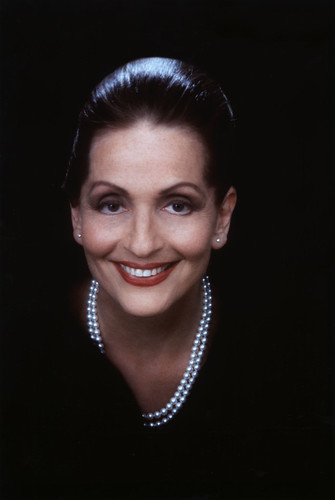
Hildegard Behrens (1937 - 2009) - II
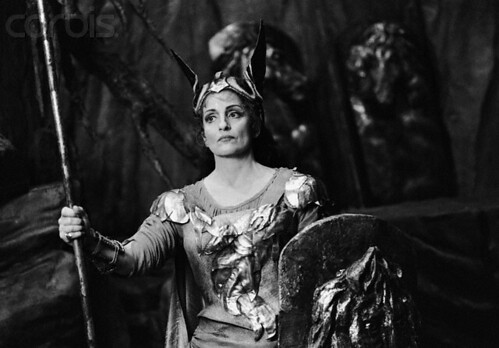
(Behrens como Brünnhilde)
Falemos claro, no tocante a Behrens, recentemente falecida: não era um soprano mítico, sendo um grande e destacado soprano dramático.
Pela parte que me toca – à excepção de Salome (o seu maior triunfo) -, Behrens foi uma notável wagneriana, sobretudo, rivalizando com a belíssima G. Jones. Brilhou como Senta, Isolda e Brünnhilde (ei-la na produção grandiosa e datada de Schenk). Compôs, ainda, uma destacada Leonora (Fidelio) e uma assinalável Mulher do Tintureiro (A Mulher Sem Sombra). Na fase decadente da carreira, foi uma das mais proeminentes Elektra – também é verdade que poucas eram as concorrentes…
Eis uma síntese da revista de imprensa sobre o desaparecimento desta reputadíssima intérprete, quiçá a mais humana de todas as intérpretes wagnerianas (pela fragilidade e doçura das suas incarnações):
«La soprano allemande Hildegard Behrens, célèbre pour ses interprétations d'héroïnes wagnériennes, est morte au Japon, mardi 18 août, à l'âge de 72 ans. Admise dimanche dans un hôpital de Tokyo à la suite d'un malaise, Mme Behrens est décédée d'une rupture d'anévrisme, a expliqué un responsable du secrétariat du festival international d'été de musique de Kusatsu, où la chanteuse devait se produire jeudi.
Hildegard Behrens fait ses débuts en 1971 à Freibourg, dans le rôle de la Comtesse des Noces de Figaro, de Mozart. Cinq ans plus tard elle se trouve sur la scène du Metropolitan Opera de New York, interprétant Giorgetta dans Il Tabarro, de Puccini – elle se produira 171 fois sur cette scène prestigieuse, la dernière fois en 1999. Mais c'est au festival de Salzbourg, dans le rôle-titre de Salome, de Richard Strauss, qu'elle conquiert son public.
Dans les années 80, ses interprétations de Wagner, et notamment du rôle de Brünnhilde dans la Tétralogie, assurent sa notoriété. Soprano dramatique, ses grands rôles incluent également Elettra dans Idomeneo et Donna Anna dans Don Giovanni, de Mozart, Fidelio dans l'opéra homonyme de Beethoven, Isolde dans Tristan und Isolde et Senta dans Le Vaisseau fantôme, de Wagner, Santuzza dans Cavalleria Rusticana, de Mascagni, les rôl es-titres dans Elektra et Salome de Richard Strauss et Marie dans Wozzeck de Berg.»
«Soprano Hildegard Behrens, one of the finest Wagnerian performers of her generation, has died while traveling in Japan. She was 72.
Jonathan Friend, artistic administrator of the Metropolitan Opera in New York, said Tuesday in an e-mail to opera officials that Behrens felt unwell while traveling to a festival near Tokyo. She went to a Tokyo hospital, where she died of an apparent aneurism.
Friend's e-mail was shared with The Associated Press by Jack Mastroianni, director of IMG Artists.
Her funeral was planned in Vienna.
Organizers for Behrens' visit in Japan said she was in this country to teach lessons in the hot springs resort town of Kusatsu, north of Tokyo, from Aug. 21-29. The lessons were being sponsored by the Kanshinetsu Music Association.
The organizers declined to comment further.
A Web site for the Kusatsu Summer Music Festival said Behrens' performances had been canceled, but gave no further details. It said she was to perform on Aug. 20.
According to Behren's official Web site, she was born in the north German town of Varel-Oldenburg. Her parents were both doctors and she and her five siblings studied piano and violin as children.
It said she earned a law degree from the University of Freiburg, where she also was a member of the student choir.
She was named singer of the year in 1997 by the German opera magazine Die Opernwelt and singer of the year for 1996 by the German opera magazine Orpheus.»
«The German soprano Hildegard Behrens, a mesmerizing interpreter of touchstone dramatic soprano roles like Wagner’s Brünnhilde and Strauss’s Salome during the 1980s and early ’90s, died on Tuesday in Tokyo. She was 72 and lived in Vienna.
Her death was announced by Jonathan Friend, the artistic administrator of the Metropolitan Opera, in an e-mail message sent to associates and released to the media by Jack Mastroianni, director of the vocal division at IMG Artists and her former manager.
Ms. Behrens fell ill while traveling to a festival in Kusatsu, a Japanese resort town, to present master classes and a recital, and was taken to a hospital in Tokyo on Sunday night. She died there apparently of an aneurysm, Mr. Friend wrote.
Ms. Behrens’s ascent into the demanding Wagnerian soprano repertory was uncommonly fast after starting her career late. She did not begin vocal studies, at the Freiburg Academy of Music, until she was 26, the same year she graduated from the University of Freiburg in Germany as a junior barrister, having initially chosen law as a profession.
Her debut came in Freiburg in February 1971, the month she turned 34, in a lyric soprano role, the Countess in Mozart’s “Nozze di Figaro.” Her voice at the time was rich and flexible, and she might have continued on a lighter repertory path. But the shimmering allure and power of her sound and the intensity of her singing led her inexorably to Wagner.
In her prime she was a complete vocal artist, a singer whose warm, textured voice could send phrases soaring. Her top notes could slice through any Wagner orchestra.
Her technique made heavy use of chest voice, an approach that would eventually take a toll on her singing. Many purists argued that Ms. Behrens was no born Wagnerian. Her voice lacked the penetrating solidity of a Kirsten Flagstad or the clarion brilliance of a Birgit Nilsson.
Yet with her deep intelligence, dramatic fervor and acute emotional insights, she made her voice do what the music and the moment demanded. A beautiful woman with dark hair and a slender athletic frame, she was a poignant actress capable of fits and temperamental flashes onstage.
She was riveting as Wagner’s Isolde, a role she recorded with Leonard Bernstein conducting; Senta from “Der Fliegende Holländer”; and, especially, Brünnhilde.
She learned the three Brünnhilde roles of Wagner’s “Ring” cycle (in “Die Walküre,” “Siegfried” and “Götterdämmerung”) simultaneously, because she thought of the cycle’s four operas as an entity, an organic operatic drama. Her first Brünnhilde came with a complete “Ring” at the Bayreuth Festival in Germany in 1983, the production conducted by Georg Solti. It was a triumph for Ms. Behrens, which she repeated for the next three summer seasons there.
She sang the role when the Met opened its 1986-87 season with “Die Walküre,” the first installment of Otto Schenk’s production. In the spring of 1989 she sang in the Met’s first presentation of the complete Schenk “Ring,” which was designed with her in mind. The production was retired this May.
Between her Met debut as Giorgetta in Puccini’s “Tabarro” in 1976 and her appearances as Marie in Berg’s “Wozzeck” in 1999, she sang 171 performances with the company, including Leonore in Beethoven’s “Fidelio,” Elettra in Mozart’s “Idomeneo” and the title roles in Strauss’s “Salome” and “Elektra.” She sang the title role in Puccini’s “Tosca” opposite Plácido Domingo in the premiere of the popular Franco Zeffirelli staging introduced in 1985, a production later broadcast on public television.
Still, Brünnhilde became her Met calling card. She appears in the company’s DVDs of the Schenk “Ring” — recorded mostly in 1990, when she was at her dramatic and vocal peak — with James Levine conducting. The release affectingly captures her uncommonly feminine and thoughtful portrayal of this rambunctious character.
Yet Ms. Behrens’s move into Wagner was an act of will that took a vocal toll. By the mid-1990s, when she was approaching 60, her singing became ragged, with dicey pitch and strident top notes. Ms. Behrens drew criticism from many opera buffs and reviewers during this period. But she was determined to sing her chosen roles with uncompromising intensity, whatever the cost.
Hildegard Behrens was born on Feb. 9, 1937, in Varel, Germany, west of Hamburg, the youngest of six children. Both her parents were doctors, and her father was an avid amateur musician. As a child Ms. Behrens studied piano and violin and had a natural singing voice. Commenting on her musical upbringing in a 1983 interview with The New York Times, she said, “Nobody cared for me, and I had no expectations.” Hence her drift into law school.
Her true talent did not emerge until well into her vocal studies in Freiburg. In 1972 she joined the Deutsche Oper in Düsseldorf. She was discovered there by the powerful conductor Herbert von Karajan, who recruited her to sing Salome at the Salzburg Festival in Austria in 1977. The experience was exasperating for the determined Ms. Behrens: Karajan insisted that a nonsinger perform Salome’s Dance of the Seven Veils. Still, her performance was acclaimed and led to a landmark recording.
In the 1983 interview Ms. Behrens explained that she knew from the beginning that she would become a dramatic soprano, and that her slow start was an advantage.
“I consider my career to have had a fantastic logic,” she said, adding, “Now I realize that all that time I spent at the conservatory allowed me to evolve as a musician.”
“It was like playing a role out in my mind, before I actually did it. Even today I can think through a part, and my throat will subconsciously assume all the correct positions without my actually having to sing.”
By the early 1980s Ms. Behrens was such a major Met artist that she considered her loft in Chelsea home; she lived there at the time with her two children. Ms Behrens’s children, Philip Behrens of Munich and Sara Behrens Schneidman of Vienna, survive her, along with two grandchildren. She was married for a time to the German director Seth Schneidman, who directed her in several productions.
Ms. Behrens saw no divide between acting and singing. “Music for me comes out of the dramatic context,” she said in a 1997 interview with Opera News. “I have never had the temptation to view the voice as a fetish. For me it’s just a vehicle. I cannot consider it as some kind of golden calf.”
In 1990, while performing in the “Ring” at the Met, Ms. Behrens sustained a severe injury when a piece of scenery fell on her during the final scene of “Götterdämmerung,” the dramatic climax in which the Hall of the Gibichungs collapses. A beam of plastic foam and canvas stretched over wood fell prematurely and knocked Ms. Behrens to the floor, bruising her forehead and blackening her eyes. She had to miss subsequent performances. In a statement at the time, she said that if the beam had not struck her she might have taken a fatal fall into an open shaft created by a premature lowering of part of the stage floor.
Ms. Behrens was not an artist who looked back at decisions with regret, including her early choice of law school. She found helpful connections between law and opera.
“You go step by step in law,” she said in the Opera News interview, “and that’s what you do in opera too — finding motivations, reasons, cause and effect, emotions, guilt, responsibility. The intellectual training and discipline that it takes to solve a juridical case are very good for the approaches to a role.”»
Falemos claro, no tocante a Behrens, recentemente falecida: não era um soprano mítico, sendo um grande e destacado soprano dramático.
Pela parte que me toca – à excepção de Salome (o seu maior triunfo) -, Behrens foi uma notável wagneriana, sobretudo, rivalizando com a belíssima G. Jones. Brilhou como Senta, Isolda e Brünnhilde (ei-la na produção grandiosa e datada de Schenk). Compôs, ainda, uma destacada Leonora (Fidelio) e uma assinalável Mulher do Tintureiro (A Mulher Sem Sombra). Na fase decadente da carreira, foi uma das mais proeminentes Elektra – também é verdade que poucas eram as concorrentes…
Eis uma síntese da revista de imprensa sobre o desaparecimento desta reputadíssima intérprete, quiçá a mais humana de todas as intérpretes wagnerianas (pela fragilidade e doçura das suas incarnações):
«La soprano allemande Hildegard Behrens, célèbre pour ses interprétations d'héroïnes wagnériennes, est morte au Japon, mardi 18 août, à l'âge de 72 ans. Admise dimanche dans un hôpital de Tokyo à la suite d'un malaise, Mme Behrens est décédée d'une rupture d'anévrisme, a expliqué un responsable du secrétariat du festival international d'été de musique de Kusatsu, où la chanteuse devait se produire jeudi.
Hildegard Behrens fait ses débuts en 1971 à Freibourg, dans le rôle de la Comtesse des Noces de Figaro, de Mozart. Cinq ans plus tard elle se trouve sur la scène du Metropolitan Opera de New York, interprétant Giorgetta dans Il Tabarro, de Puccini – elle se produira 171 fois sur cette scène prestigieuse, la dernière fois en 1999. Mais c'est au festival de Salzbourg, dans le rôle-titre de Salome, de Richard Strauss, qu'elle conquiert son public.
Dans les années 80, ses interprétations de Wagner, et notamment du rôle de Brünnhilde dans la Tétralogie, assurent sa notoriété. Soprano dramatique, ses grands rôles incluent également Elettra dans Idomeneo et Donna Anna dans Don Giovanni, de Mozart, Fidelio dans l'opéra homonyme de Beethoven, Isolde dans Tristan und Isolde et Senta dans Le Vaisseau fantôme, de Wagner, Santuzza dans Cavalleria Rusticana, de Mascagni, les rôl
es-titres dans Elektra et Salome de Richard Strauss et Marie dans Wozzeck de Berg.»«Soprano Hildegard Behrens, one of the finest Wagnerian performers of her generation, has died while traveling in Japan. She was 72.
Jonathan Friend, artistic administrator of the Metropolitan Opera in New York, said Tuesday in an e-mail to opera officials that Behrens felt unwell while traveling to a festival near Tokyo. She went to a Tokyo hospital, where she died of an apparent aneurism.
Friend's e-mail was shared with The Associated Press by Jack Mastroianni, director of IMG Artists.
Her funeral was planned in Vienna.
Organizers for Behrens' visit in Japan said she was in this country to teach lessons in the hot springs resort town of Kusatsu, north of Tokyo, from Aug. 21-29. The lessons were being sponsored by the Kanshinetsu Music Association.
The organizers declined to comment further.
A Web site for the Kusatsu Summer Music Festival said Behrens' performances had been canceled, but gave no further details. It said she was to perform on Aug. 20.
According to Behren's official Web site, she was born in the north German town of Varel-Oldenburg. Her parents were both doctors and she and her five siblings studied piano and violin as children.
It said she earned a law degree from the University of Freiburg, where she also was a member of the student choir.
She was named singer of the year in 1997 by the German opera magazine Die Opernwelt and singer of the year for 1996 by the German opera magazine Orpheus.»
«The German soprano Hildegard Behrens, a mesmerizing interpreter of touchstone dramatic soprano roles like Wagner’s Brünnhilde and Strauss’s Salome during the 1980s and early ’90s, died on Tuesday in Tokyo. She was 72 and lived in Vienna.
Her death was announced by Jonathan Friend, the artistic administrator of the Metropolitan Opera, in an e-mail message sent to associates and released to the media by Jack Mastroianni, director of the vocal division at IMG Artists and her former manager.
Ms. Behrens fell ill while traveling to a festival in Kusatsu, a Japanese resort town, to present master classes and a recital, and was taken to a hospital in Tokyo on Sunday night. She died there apparently of an aneurysm, Mr. Friend wrote.
Ms. Behrens’s ascent into the demanding Wagnerian soprano repertory was uncommonly fast after starting her career late. She did not begin vocal studies, at the Freiburg Academy of Music, until she was 26, the same year she graduated from the University of Freiburg in Germany as a junior barrister, having initially chosen law as a profession.
Her debut came in Freiburg in February 1971, the month she turned 34, in a lyric soprano role, the Countess in Mozart’s “Nozze di Figaro.” Her voice at the time was rich and flexible, and she might have continued on a lighter repertory path. But the shimmering allure and power of her sound and the intensity of her singing led her inexorably to Wagner.
In her prime she was a complete vocal artist, a singer whose warm, textured voice could send phrases soaring. Her top notes could slice through any Wagner orchestra.
Her technique made heavy use of chest voice, an approach that would eventually take a toll on her singing. Many purists argued that Ms. Behrens was no born Wagnerian. Her voice lacked the penetrating solidity of a Kirsten Flagstad or the clarion brilliance of a Birgit Nilsson.
Yet with her deep intelligence, dramatic fervor and acute emotional insights, she made her voice do what the music and the moment demanded. A beautiful woman with dark hair and a slender athletic frame, she was a poignant actress capable of fits and temperamental flashes onstage.
She was riveting as Wagner’s Isolde, a role she recorded with Leonard Bernstein conducting; Senta from “Der Fliegende Holländer”; and, especially, Brünnhilde.
She learned the three Brünnhilde roles of Wagner’s “Ring” cycle (in “Die Walküre,” “Siegfried” and “Götterdämmerung”) simultaneously, because she thought of the cycle’s four operas as an entity, an organic operatic drama. Her first Brünnhilde came with a complete “Ring” at the Bayreuth Festival in Germany in 1983, the production conducted by Georg Solti. It was a triumph for Ms. Behrens, which she repeated for the next three summer seasons there.
She sang the role when the Met opened its 1986-87 season with “Die Walküre,” the first installment of Otto Schenk’s production. In the spring of 1989 she sang in the Met’s first presentation of the complete Schenk “Ring,” which was designed with her in mind. The production was retired this May.
Between her Met debut as Giorgetta in Puccini’s “Tabarro” in 1976 and her appearances as Marie in Berg’s “Wozzeck” in 1999, she sang 171 performances with the company, including Leonore in Beethoven’s “Fidelio,” Elettra in Mozart’s “Idomeneo” and the title roles in Strauss’s “Salome” and “Elektra.” She sang the title role in Puccini’s “Tosca” opposite Plácido Domingo in the premiere of the popular Franco Zeffirelli staging introduced in 1985, a production later broadcast on public television.
Still, Brünnhilde became her Met calling card. She appears in the company’s DVDs of the Schenk “Ring” — recorded mostly in 1990, when she was at her dramatic and vocal peak — with James Levine conducting. The release affectingly captures her uncommonly feminine and thoughtful portrayal of this rambunctious character.
Yet Ms. Behrens’s move into Wagner was an act of will that took a vocal toll. By the mid-1990s, when she was approaching 60, her singing became ragged, with dicey pitch and strident top notes. Ms. Behrens drew criticism from many opera buffs and reviewers during this period. But she was determined to sing her chosen roles with uncompromising intensity, whatever the cost.
Hildegard Behrens was born on Feb. 9, 1937, in Varel, Germany, west of Hamburg, the youngest of six children. Both her parents were doctors, and her father was an avid amateur musician. As a child Ms. Behrens studied piano and violin and had a natural singing voice. Commenting on her musical upbringing in a 1983 interview with The New York Times, she said, “Nobody cared for me, and I had no expectations.” Hence her drift into law school.
Her true talent did not emerge until well into her vocal studies in Freiburg. In 1972 she joined the Deutsche Oper in Düsseldorf. She was discovered there by the powerful conductor Herbert von Karajan, who recruited her to sing Salome at the Salzburg Festival in Austria in 1977. The experience was exasperating for the determined Ms. Behrens: Karajan insisted that a nonsinger perform Salome’s Dance of the Seven Veils. Still, her performance was acclaimed and led to a landmark recording.
In the 1983 interview Ms. Behrens explained that she knew from the beginning that she would become a dramatic soprano, and that her slow start was an advantage.
“I consider my career to have had a fantastic logic,” she said, adding, “Now I realize that all that time I spent at the conservatory allowed me to evolve as a musician.”
“It was like playing a role out in my mind, before I actually did it. Even today I can think through a part, and my throat will subconsciously assume all the correct positions without my actually having to sing.”
By the early 1980s Ms. Behrens was such a major Met artist that she considered her loft in Chelsea home; she lived there at the time with her two children. Ms Behrens’s children, Philip Behrens of Munich and Sara Behrens Schneidman of Vienna, survive her, along with two grandchildren. She was married for a time to the German director Seth Schneidman, who directed her in several productions.
Ms. Behrens saw no divide between acting and singing. “Music for me comes out of the dramatic context,” she said in a 1997 interview with Opera News. “I have never had the temptation to view the voice as a fetish. For me it’s just a vehicle. I cannot consider it as some kind of golden calf.”
In 1990, while performing in the “Ring” at the Met, Ms. Behrens sustained a severe injury when a piece of scenery fell on her during the final scene of “Götterdämmerung,” the dramatic climax in which the Hall of the Gibichungs collapses. A beam of plastic foam and canvas stretched over wood fell prematurely and knocked Ms. Behrens to the floor, bruising her forehead and blackening her eyes. She had to miss subsequent performances. In a statement at the time, she said that if the beam had not struck her she might have taken a fatal fall into an open shaft created by a premature lowering of part of the stage floor.
Ms. Behrens was not an artist who looked back at decisions with regret, including her early choice of law school. She found helpful connections between law and opera.
“You go step by step in law,” she said in the Opera News interview, “and that’s what you do in opera too — finding motivations, reasons, cause and effect, emotions, guilt, responsibility. The intellectual training and discipline that it takes to solve a juridical case are very good for the approaches to a role.”»
quinta-feira, 20 de agosto de 2009
Hildegard Behrens (1937 - 2009)

Oportunamente, volverei ao tema.
Para mim, entrou para a história quando, em Salzburgo, sob a orientação do Mestre, interpretou uma das mais extraordinárias Salome.
Para mim, entrou para a história quando, em Salzburgo, sob a orientação do Mestre, interpretou uma das mais extraordinárias Salome.
Subscrever:
Mensagens (Atom)