Mostrar mensagens com a etiqueta Stemme. Mostrar todas as mensagens

quarta-feira, 8 de dezembro de 2010

7/12


Em operês, a data que dá título a este post constitui um marco incontornável, dado que corresponde ao arranque da temporada lírica milanesa. Desta feita, envolta em contestação e tomadas de posição políticas (por parte de quem, por regra, raramente o faz, dentro de um teatro lírico...), a luxuosa A Valquíria afirmou-se como cereja que encima o bolo do Sr. Lissner, ossia il sgnor alla scala.

Fiquemos, por ora, com as primeiras impressões da première:

"
On attendait avec impatience La Walkyrie qui ouvrait le samedi 4 décembre la saison de la Scala, avant la soirée officielle du 7 décembre. Une impatience à la mesure de l'impression laissée en mai dernier par L'Or du Rhin mis en scène par le Flamand Guy Cassiers, prologue de ce Ring qui s'annonce déjà comme la clef de voûte de l'ère Stéphane Lissner (Le Monde du 29 mai).

La Scala réunit l'une des meilleures distributions du moment. Elle a pourtant dû faire face au désistement, pour raisons de santé, de l'excellente basse allemande René Pape (46 ans), sans doute le meilleur Wotan actuel.

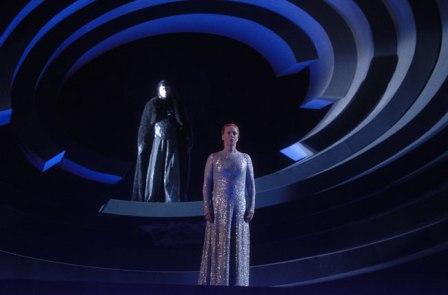
Le rôle a été confié au jeune Ukrainien Vitalij Kowaljow, dont la cote ne cesse de monter depuis que Placido Domingo en a fait le dieu des dieux de la première Tétralogie montée à l'Opéra de Los Angeles, en mai. S'il possède moins d'autorité et d'abattage que son aîné, Kowaljow ne démérite pas. C'est également le cas de deux autres débutants sur la scène milanaise : le vétéran John Tomlinson (Hunding impressionnant malgré sa voix fatiguée) et le jeune ténor néo-zélandais Simon O'Neill (39 ans), Siegmund acclamé notamment à Bayreuth, légèrement en deçà de sa réputation. Car ce sont les femmes qui ont tenu le plateau en haleine. D'abord Waltraud Meier (Isolde fétiche du Tristan de Patrice Chéreau), peut-être pas une grande Sieglinde, mais toujours wagnérienne-née. Puis la Fricka grand luxe d'Ekaterina Gubanova, somptueuse de timbre, de présence, de musicalité. Et, la Brünnhilde troublante et lumineuse de Nina Stemme : plus qu'une voix de rêve, un rêve incarné de guerrière pétrie d'humanité.

Magique baguette

Guy Cassiers a l'intelligence de ses interprètes : il réussit un spectacle beau et puissant. Les ballets de L'Or du Rhin, qui marquaient les dieux à la culotte, ont disparu, si l'on excepte au troisième acte une manière de vol baroque avec ballet équestre et nuées de guerriers morts au Walhalla. L'ingénieux dispositif de vidéos a encore gagné en pertinence. Que ce soit la boîte qui sert de hutte aux amours de Siegmund et Sieglinde, dont les parois paraissent vivantes, la forêt de lances ou le Walhalla, désert sidéral traversé d'explosions, d'astéroïdes et de comètes.

Mais le vrai Wotan est dans la fosse, dans l'Orchestre de la Scala que dirige un Daniel Barenboïm maître d'oeuvre de ce Ring. C'est lui, le héraut wagnérien à la puissante rêverie déployée dans l'espace, l'esprit en émoi, les sens en alerte, qu'il raffine en poète chambriste ou envoûte en démiurge du grand tout symphonique.
"

Apesar da ausência de Pape como Wotan - souffrant... -, Meier, Stemme e o magistral Barenboim tornaram esta noite num acontecimento.

quinta-feira, 1 de julho de 2010

(algumas) Mulheres da nossa lírica...

Fleming, Stemme, Dessay, Bartoli e Westroek.
Claro está, eu acrescentaria Mattila, Matos (Elisabete), Didonato, Voigt e Netrebko!!!

«Renée Fleming
Versatile and technically assured American soprano with a huge international reputation, who reigns as undisputed queen of New York’s Metropolitan Opera. Along with her sterling professionalism and acting skills, she has a gorgeously even and creamy voice that excels in late romantic music, but she can also sing show tunes and (as her latest album Dark Hope demonstrates) soft rock. Some critics find her interpretations bland and her style smoochy, but it’s hard to think of anyone who delivers the goods so consistently, looks great in Valentino and Versace on the concert platform and has had a dessert and a scent named after her. A regular at Covent Garden, she will sing at this year’s Last Night of the Proms.


Nina Stemme
This attractive and highly intelligent Swedish soprano carries the torch for the long Scandinavian tradition of Wagner singing and her interpretation of the role of Isolde is universally considered to rank among the very greatest in history. Pacing her career carefully and balancing its demands with bringing up a family in Stockholm, she will be undertaking the even more demanding role of Brünnhilde in The Ring cycle for the first time in San Francisco this autumn. Also ranks as an accomplished and stylish singer of Verdi’s more dramatic operas. She will be singing Leonore in Beethoven’s Fidelio at Covent Garden in 2011.

Natalie Dessay
An enchantingly quirky and individual French soprano with a tiny physical frame, light, small voice and outsize personality. Recently sang the comic role of Marie in La Fille du Régiment at Covent Garden to wild acclaim, and is also celebrated for her portrayal of tragic operatic heroines such as Lucia in Lucia di Lammermoor and Ophélie in Thomas’s Hamlet.

Despite an injury to her vocal cords, her flexibility and prowess above the stave remains impressive. Next season in Paris she undertakes Cleopatra in Giulio Cesare, a debut which should show off her talents to perfection. London hears her next as Mélisande in Pelléas et Mélisande at the Barbican in April .

Cecilia Bartoli
A phenomenal singer with an idiosyncratic technique, born in Rome to opera-singer parents. Started her career as a mezzo-soprano but has now pushed into high soprano territory, with often controversial results. Focuses her repertory largely on Italian music of the pre-Verdi era, and makes few operatic appearances outside Zurich, where she lives.

Hugely successful on record (she has been exclusively contracted to Decca for two decades) and in concert, she is rumoured to be the most highly paid classical artist in the world today. Love her or hate her – and some find her mannerisms infuriating – there’s no denying her star quality or musical integrity. Her fans keenly await her first attempt at the supremely testing title role in Bellini’s Norma in Germany this summer.

Eva-Maria Westbroek
One of today’s most impressive examples of a true singing actress, whose performances are as remarkable for dramatic subtlety as for vocal prowess. Born in the Netherlands, she began her career as a singing waitress in an Amsterdam restaurant but soon won herself a huge reputation singing a largely German repertory in European opera houses.

A favourite at Covent Garden since her stunningly powerful performances as Sieglinde in Die Walküre and Katerina in Shostakovich’s Lady Macbeth of Mtsensk, she returns here in the 2010-2011 season to sing two major roles – the saintly Elisabeth in Tannhaüser and the less than saintly Anna Nicole Smith in the premiere of Mark-Anthony Turnage’s new opera Anna Nicole.»

sábado, 20 de fevereiro de 2010

Nina auf Naxos


(Nina Stemme como protagonista de Ariadne auf Naxos - Met Opera House)

Há uns bons dez anos, por causa desta superlativa Ariadne auf Naxos, quase perdi o voo de regresso a casa! A protagonista era a magnífica Deborah Voigt que, à época, se encontrava na plena posse das suas infinitas qualidades vocais. Pouco antes, gravara o mesmo papel, sob a direcção do saudoso Sinopoli.

Voigt foi a Ariadne da década, sem sombra de dúvida. Consta que Sinopoli a escolhera em substituição da sua straussiana fétiche – Cheryl Studer -, by the time em acelerada decadência.

A razão de ser deste post tem que ver com a estreia de Nina Stemme no papel titular de Ariadne auf Naxos. Segundo reza a notícia, Stemme foi um prodígio. Não admira! É do melhor que há, desde a sua triunfal Isolde.

Stemme é a sucessora de Voigt, está bem de ver. O resto, é número!


«(...) the Swedish soprano Nina Stemme sang the title role as scheduled and sounded as healthy as could be. I have admired Ms. Stemme since hearing her lustrous and intense performance as Wagner’s Isolde at Bayreuth in 2006. She was in excellent voice here, singing with earthy colorings, ample power and vivid character.

In this opera-within-an-opera the lead role is actually an unnamed prima donna, whom we meet in the Prologue, backstage at the private theater of the wealthiest man in Vienna, who is giving a party. The guests will be entertained with the premiere of a tragic opera, “Ariadne auf Naxos,” and a song-and-dance show from a troupe of comedic players. To save time, however, the unseen host orders that the opera and the comedy be performed simultaneously.

Balancing the elements of farce, social commentary and idealized love in “Ariadne auf Naxos” is a challenge. Despite Ms. Stemme’s compelling singing and the radiant, sensitive playing the conductor Kirill Petrenko drew from the Met Orchestra, the overall performance seemed tentative well before the crucial final scene, when the ailing Mr. Hendrick arrived as Bacchus to rescue Ariadne from her broken-hearted isolation.

(...)

But Ms. Stemme’s performance is the news.»

sábado, 26 de setembro de 2009

Da Isolda

Eis algumas interessantes considerações sobre o papel dos papéis de soprano:

«"Isolde is a severe test for the voice," the Norwegian soprano Kirsten Flagstad – Isolde on the famous recording under Wilhelm Furtwängler – once observed. "Either it can be completely destroyed, or it can grow, as mine did." But Isolde is a great acting part, too. "It isn't all loud and screamy like the stereotypes," says Bullock. "It's a Shakespearean role, really."

Not surprisingly, many sopranos are nervous when the idea of Isolde is first mooted. In the 90s, the late Sir Georg Solti asked American soprano Renée Fleming if she would sing the role for a production he was planning. Fleming looked at the score, decided that her voice would never be the same, and refused. A generation earlier, Dame Margaret Price was persuaded to sing Isolde for a recording under German conductor Carlos Kleiber. The result, made up from several takes, is one of the most outstanding recorded Isoldes. Efforts to tempt Price to do Isolde on the stage, however, never came to anything. "I'm not a long-distance runner," she insisted. "I'll sing it to my dogs."

Price's performance has had lasting effects on today's Isoldes. Before her, the role belonged to sopranos such as Flagstad and the late Birgit Nilsson, massive of voice, with a laser-like precision of tone. Price came from another, more Italianate vocal tradition. Bullock says: "Isolde wasn't something I was thinking of until I was asked. But listening to Price made me realise it could be done. I think if I had started by listening to Nilsson I would have committed suicide."

Stemme adds: "I thought my first offer of Isolde was a joke." Stemme, at that time, was more a lyric Mozartian singer than a dramatic Wagnerian. "But a seed was planted. I went away and studied the role and realised it would be possible."

The role can certainly take its toll on a soprano's voice. As a young woman, the Scottish soprano Linda Esther Gray won great acclaim for her exceptional interpretation of the role under the renowned Wagnerian conductor Reginald Goodall for Welsh National Opera in the 70s. But Gray was rarely the same singer afterwards and her career was sadly cut short. The fine Viennese singer Helga Dernesch was another whose career struggled to recover from Herbert von Karajan's decision to cast her as Isolde in performances and on record in the 70s.

But if Isolde can be unforgiving it can also be incomparably rewarding. If there is one singer whom today's Isoldes revere more than any other, it is the Berlin-born soprano Frida Leider, who dominated the role in the interwar years. "Ah, Leider, she is the winner," says Stemme. "She's got it all." Evans agrees: "There's never just one way of doing anything. But it's the vibrancy of her sound that marks Leider out. All those colours in the voice."

Leider's recordings – sadly only of excerpts from the opera – point a path to the heart of the role. In her autobiography, Leider explains with great clarity how she approached Isolde. "I always tried to sing in the Italian bel canto style, and above all, I endeavoured to incorporate this style into my Wagner interpretations. I put my enunciation under the microscope. I accentuated very sharply but tried to do this while sustaining my vocal line."

It all sounds so simple. But it is the key to climbing the Wagnerian Everest and surviving to do it all over again a few nights later. Isoldes of this class are rare. Price came close, but only in the recording studio. The late Hildegard Behrens, who made an extraordinary recording of the opera under Leonard Bernstein, was probably the best of the rest in recent times. Now though, there is another name to add to the list. When I ask Evans to name her favourites, she replies: "First Leider, then Behrens – and now Nina Stemme," she responds. "I think she is very special."»

Pela parte que me toca, além das clássicas, que se estenda um longo tapete vermelho às Senhoras Stemme, Voigt e Meier - todas elas no activo. E quem nunca viu a Isolda da Stemme, verdadeiramente, nunca tomou contacto com a plenitude wagneriana...

Stemme é a minha Isolde, sem rival alguma - e conto com cerca de uma quinzena das maiores da história!

A POLÉMICA ESTÁ INSTALADA... CHOVAM OS COMENTÁRIOS!!!


(Nina Stemme, como Isolde - Glyndebourne)

quarta-feira, 13 de abril de 2005

Ainda e Sempre Wagner... O Crepúsculo das gravações em estúdio

Em Janeiro passado, o The Independent, o New York Times e a Diapason oficializaram um rumor que há muito circulava nos meios editoriais: Tristão e Isolda, com Domingo e Stemme, dirigidos por Pappano, seria a derradeira gravação em estúdio de uma ópera.

Como amante de ópera que sou, não fiquei indiferente diante deste facto - tudo leva a crer - inexorável...

A polémica
Live vs Estudio, no que à gravação de opera concerne, tem animado, desde há décadas, um aceso debate.
Se os partidários das gravações ao vivo, nos espaços próprios - que são as salas de ópera - se assumem como defensores acérrimos da espontaneidade e do purismo, os apoiantes da gravação em estúdio fundamentam a sua opção, nomeadamente, no respeito escrupuloso pelas partituras e na possibilidade de se produzirem artigos próximos da perfeição, ainda que, em certo sentido, artificialmente...

A minha posição - que não é ortodoxa - não se revê em nenhuma destas extremadas teses. Creio haver espaço para ambos os registos.

Aliás, a história da edição de música é prolixa em artigos que desmentem as extremadas posições que acima caracterizei, desconstruindo os argumentos que cada uma delas aduz !

Senão, vejamos o caso de
Tristão e Isolda.

Desta monumental ópera, tenho 9 registos, sendo dois em dvd.

Porque será que figura entre as melhores interpretações a de Furtwangler, com Flagstad ?
Et pourtant, todos sabemos que, nas passagens mais agudas, Schwarzkopf emprestou a sua ágil voz à interprete oficial da gravação, já entradota na idade, by the time !

A gravação de Bohm, com Windgassen e Nilsson, em meu entender, encontra-se, também, entre as melhores interpretações desta ópera. Trata-se de um
live, captado em 66... e sem batota !

E a fogosa leitura de Fritz Reiner, com Melchior e Flagstad (novíssima !), igualmente captada ao vivo, em Covent Garden ??

Baralhemos a coisa...

Carlos Kleiber realizou, da ópera em debate, uma prodigiosa gravação, paradigmática do artificialismo.
O (divino) maestro escolheu M. Price para encarnar a heroína feminina...
Na altura, esta escolha fez correr tinta e mais tinta, tendo alguns vaticinado uma catástrofe !
O milagre produziu-se, estando aí para quem tiver dúvidas.
Price - que nunca abordou o papel, em cena, por lhe escaparem os recursos necessários - aceitou o desafio do maestro. Acedeu em gravar o papel, ao longo de intermináveis sessões (durante dois anos !), em estúdio.

Domingo chegou a assinar contrato com a direcção de Bayreuth para interpretar Tristão, sob proposta de Barenboim. Porém, à última da hora, cancelou as récitas. Num gesto de inteligência e de humildade disse que, se o tivesse encarnado, a sua voz pagaria uma factura elevadíssima, comprometendo o resto da sua carreira ! Note-se que este episódio teve lugar em inícios da década de 90, quando o interprete se lançou, em pleno, na interpretação dos papeis de
heldentenor !

Para finalizar - e para provar quão etéreas são as ortodoxas posições pró e contra o estúdio /
live - proponho que se comparem as duas gravações realizadas por Karajan.
A primeira, captada em Bayreuth, com Modl e Vinay, é prodigiosa, rica, colossal e homogénea; a segunda, apenas é salva pelo Tristão de Vickers, contando com uma das mais desastrosas Isoldas da discografia: Dernesch... Nem o estúdio ajudou !

Creio haver espaço para ambas as formas de registo, cuja qualidade em nada tem que ver com o local e a forma de captação !

Outra coisa é o final das gravações em estúdio - trágica notícia, essa sim...-, por questões estritamente financeiras, absolutamente estranhas à polémica a que aludi neste post...