Mostrar mensagens com a etiqueta Carmen. Mostrar todas as mensagens

quinta-feira, 7 de abril de 2011

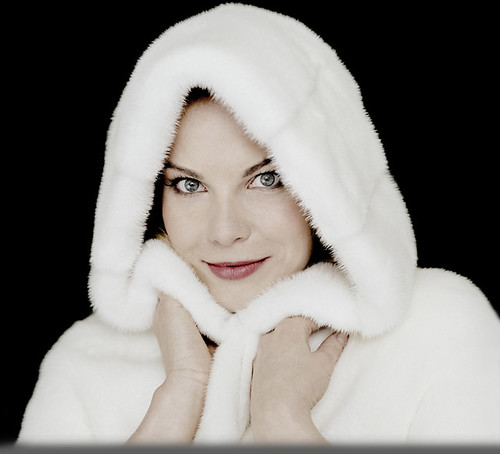
Maricarmen


(Waltraud Meier)


Em 1996, no Met, depois de atingida a glória, Waltraud Meier arrisca novos terrenos… e dá-se mal, muito mal. A sua Carmen foi absolutamente aniquilada pela crítica – sobretudo -, que a descreveu como uma fria germânica, almejando a graça latina.

Meier sofreu muitíssimo como o duro revés. Mas, como diria o outro, são “ossos do ofício”.

Doravante, regressou ao Met, apenas, no seu elemento natural, ossia Wagner.


Pessoalmente, considero Meier uma extraordinária intérprete, com uma veia dramática memorável. Embora a voz brilhe, a consagração só se dá quando representa. E como brilha a sua Kundry – a melhor da sua geração -, Isolda, Fricka, Venus, and so on

Aos 55 anos, Meier regressa ao Met, desta feita para interpretar Marie, a protagonista feminina de Wozzeck (Berg).


O excelente artigo do The New York Times disseca a relação conturbada de Meier com o Met, quase sugerindo o que me parece óbvio: la vendetta! Depois do logro de Carmen, a Marie de Meier soa a um ajuste de contas com o público e crítica Metropolitanos. Oxalá!

É que – caro e fiel leitor -, ao seu jeito, Marie é também uma Carmen, ambas criaturas claramente afins com as vicissitudes da histeria…


Her first international appearance was in Buenos Aires in 1980, as Fricka in “Das Rheingold.” She made her debut at Bayreuth in 1983 as Kundry in Wagner’s “Parsifal,” her first time working with Mr. Levine. He became her Met champion, bringing her to the company in 1987 as Fricka in the premiere of the Otto Schenk production of Wagner’s “Ring” cycle. By the time she returned in the early 1990s, she had begun taking on traditional soprano roles like Isolde and Leonore in “Fidelio.” She had acclaimed runs at the Met as Kundry in 1992 and Santuzza in Mascagni’s “Cavalleria Rusticana” in 1993. She sang Sieglinde in the first act of “Die Walküre” with Mr. Domingo on the opening night of the 1993-94 season, and was a frequent soloist in concerts with Mr. Levine and the Met Orchestra.


It is in that context that Ms. Meier’s run in “Wozzeck” finds its meaning, both for the Met audience and for her, its undercurrent of poignancy and triumph. This is her moment finally to convince us, even to seduce us. “


sábado, 6 de novembro de 2010

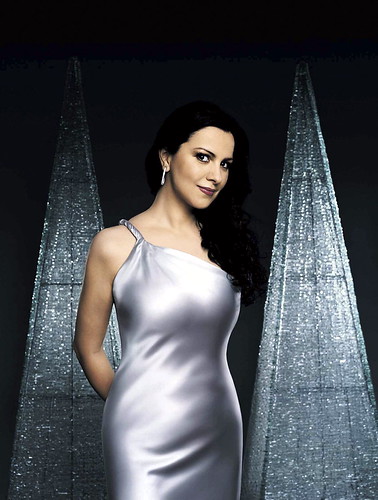
Garanca's Carmen


Aqui, tive ocasião de manifestar as minhas reservas diante da interpretação da protagonista de Carmen, proposta por Elina Garanca. É certo que a mezzo do Báltico já abordou este papel no Met, tendo-se notabilizado, aos olhos da crítica.

Por ocasião de uma reprise, no Met, de Carmen, eis o veredicto do respeitável The New York Times:


For the moment, fico na minha...

domingo, 24 de janeiro de 2010

A Carmen Met(ropolitana)


Por lapso deste escriba, a crítica desta nova Carmen do Met (dirigida por David Eyre) escapara ao olho vivo e desperto deste blog. Além de tudo, como bem saberá o avisado leitor, por estas bandas, o enterro de uma produção do insuportável Zeffirelli é motivo de celebração e regozijo!

Sendo certo que os lapsos constituem, para os psicanalistas – categoria onde me inscrevo e revejo –, material privilegiado de acesso ao inconsciente (juntamente com sonhos e sintomas - conjunto a que Freud chamou Retorno do recalcado), a escapadela deu-me que pensar: já antes, (a excitação em mim causada por) uma outra mulher esbelta e encantadora desencadeara, na minha pessoa, movimentos defensivos assaz impressionantes...

Está mais que visto que o dito lapso decorreu de uma excitação vivida como perigosa pela mente de um homem comprometido. Adiante!


A nova Carmen que o Met estreou esteve, desde a primeira hora, envolta em polémica: concebida para a Dracoulette Gheorghiu, acabou por ser interpretada pela mezzo Garanca. Gheorghiu recusou – ao que parece – contracenar com Alagna, seu ex-marido. Enfim, coisas mundanas.

Pois bem, Elina Garanca acedeu ao chamamento e interpretou uma das mais inflamadas e excitantes personagens da lírica. Gheorghiu voltará à Carmen, para duas récitas apenas, ladeada por Kaufmann. Lá terá as suas razões...


«That is easy to say, but Mr. Eyre, in his Met debut, has actually done it. With this gripping new “Carmen,” the company rang out 2009 on Thursday evening with a solid success, replacing Franco Zeffirelli’s clueless and clunky production of 1996. Other than updating the Seville setting of the opera to the 1930s from the 1830s, to invoke the brutally repressive period of the Spanish Civil War, Mr. Eyre has created an essentially traditional “Carmen.” Yet, by flushing out details that show the characters bucking against civic and sexual constraints, he uncovers the rawness and daring at the opera’s core.

In the naturalness of the performances, from that of the Latvian mezzo-soprano Elina Garanca in the title role to those of the children in the chorus who scamper into the town square to watch the changing of the guard, it is clear that Mr. Eyre has lavished attention on everyone. The singers benefited immensely from the work of the rising 34-year-old Canadian conductor Yannick Nézet-Séguin, in his Met debut, who led a bracing, fleet and fresh account of the score, although he started the rousing prelude at a breakneck, frenetic tempo.

The production’s success is something of a surprise because the advance buzz had not been encouraging. The Met conceived this as a vehicle for the soprano Angela Gheorghiu, singing the mezzo-soprano title role for the first time, and her husband, the tenor Roberto Alagna, an experienced Don José. But in August Ms. Gheorghiu withdrew from the first six of eight scheduled performances, citing “personal reasons,” which were later revealed to be marital troubles. (She and Mr. Alagna are in the process of divorce.) So the Met brought in Ms. Garanca, best known for her vocally lustrous and agile performances of Rossini. The production provides an ideal context for Ms. Garanca’s nuanced, sexy and cagey portrayal.

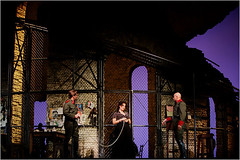
The sets and costumes by Rob Howell, in his Met debut, are crucial to the dramatic impact of Mr. Eyre’s concept. During the orchestral prelude, an ominous gray brick wall, sliced through with a blood-red slash, separates to reveal the circular arena that becomes the central scenic element of the staging. The arena’s earthen walls are crumbling in places. Rotating on a turntable, the set suggests, successively, a town square; the tavern where the Gypsies mingle with soldiers; the smugglers’ hideout in the mountains; and the area outside the bullring.

In the opening scene Mr. Eyre uses the set effectively to depict the tensions between the townspeople and the menacing soldiers. A chain-link fence surrounds the arena. On the outside, we see the soldiers in their barracks: bored, playing card games, shaving, reading newspapers. Inside, through the fence, we see the gathering crowd. When the set rotates, the square is revealed, and people stream in. We first see Mr. Alagna’s Don José, an obedient corporal, marching in step with the other solders.

The female choristers who play the Gypsies in a cigarette factory look poignantly real when they first appear (from an underground work area), wearing beige dresses and dusty factory aprons. Only Carmen wears a lacy black dress under her apron. And during the Habanera, when Carmen decides to ensnare the shy and attractive Don José, instead of prancing about the stage doing the typical Carmen dance, Ms. Garanca rinses out her sweaty apron in an open basin in the square, then coyly washes her bare legs.

Ms. Garanca does not have the sort of big, smoldering voice that many opera buffs want in a Carmen. But she sings with rich sound, an unerring feel for the nuance and subtext of a phrase, and alluring sensuality. The clarity in her singing makes this Carmen seem intelligent and wily. A lovely blonde, Ms. Garanca, 33, is captivating in her curly black wig.

Whether Mr. Alagna has made the most of his abundant vocal gifts during his career is a constant topic of discussion in opera circles. And struggling with a cold, he had to skip the final act of the dress rehearsal on Monday. On Thursday he sounded congested at times.

Yet Don José remains one of his strongest roles. The grainy texture of his sound mingles well with the nasal colors of the French language. He sings with an involving blend of intensity and refinement. To his credit, even when under the weather, he tried to sing the climactic B flat in the “Flower Song” pianissimo, as written, something few tenors do. He cracked a little but nearly pulled it off. And he gives himself over to this complex role, conveying the pitiable anguish of the weak-willed Don José, who is overcome with desire for Carmen yet disgusted with himself for abandoning his responsibilities, both to his regiment and to his forgiving mother back home.

The soprano Barbara Frittoli is wonderful as the good-hearted and constant Micaëla, an emissary from Don José’s mother. Her vibrato is sometimes overly throbbing, but the Italianate richness of her voice makes her Micaëla seem a young woman of courage and determination. And she appears achingly vulnerable with her sensible wool coat and brown satchel.

The baritone Mariusz Kwiecien absolutely looks the part of the dashing, cocky toreador Escamillo, a role that straddles the bass-baritone divide. After an uneven “Toreador Song,” music that takes him to the weaker, lower register of his voice, he sang with robust sound and panache. The bass Keith Miller was a standout as the wily officer Zuniga.

The choreographer Christopher Wheeldon has created fetching dances for this production, especially in the tavern scene, in which the Gypsies for once refrain from generic, exotic twirling and do some nifty, rhythmically intricate tapped steps.

But this is Mr. Eyre’s triumph. In only his third opera, he knew what he wanted. I have never seen the final scene, in which the crazed Don José stabs the fatalistically defiant Carmen, executed with such stunning realism, a dangerous mingling of sex, rebellion and violence: the very essence of “Carmen.”»

quinta-feira, 10 de dezembro de 2009

Carmen alla Scala '09 - III - Carmen, elle-même la Star de la soirée


(Anita Rachvelishvili, mezzo-soprano georgiano, como Carmen)

Para o
The New York Times, o triunfo desta Carmen deveu-se, justamente, à protagonista, Anita Rachvelishvili! Se o equilibrio reinou, vocalmente, já no tocante à mise-en-scène...

«
In a country where the prime minister may soon be facing actual criminal charges, that remark, like many of Mr. Zeffirelli’s own extravagant opera productions, was over the top, although Ms. Dante did lay it on too thick with the Roman Catholic symbolism. Religious processions and mourners roamed the stage as if having wandered in from the cathedral a block away, and a priest wearing a big, black Father Guido Sarducci hat held Mass and followed around the chaste Micaëla like a lawyer with his client. This was all interjected to drive home some already obvious point about the opera’s pitting conformity versus liberty.


quarta-feira, 9 de dezembro de 2009

Carmen alla Scala '09 - II - O Triunfo de Baremboim


Segundo reza esta interessantíssima leitura do El Pais, a Carmen do alla Scala, pour une fois, deveria designar-se Daniel, tal não foi a ovação suscitada pela direcção orquestral do grande, grande argentino!

«Tras la representación, hubo un cuarto de hora de encendidas aclamaciones y protestas. Las primeras centradas en lo musical, las segundas fundamentalmente en lo escénico. No hay ningún espectáculo en el mundo que levante las pasiones de la ópera. En la inauguración de La Scala llegan al límite. Daniel Barenboim fue el gran triunfador. Dirigió Carmen con una fuerza dramática impresionante. En su afán de reivindicar musicalmente una Carmen mestiza, cuyas influencias se reparten entre España, Francia, Cuba y el África negra, su mirada recaló en el espíritu de la tragedia griega. Tiempos generalmente lentos, contrastes extremos, énfasis en los sentimientos desgarrados, recreación de los mitos en tanto héroes. Barenboim se echó a las espaldas el peso musical y el teatral. Su lectura fogosa está cargada de pasión. Nos pareció que escuchábamos "otra" Carmen, o tal vez que la redescubríamos con una sensibilidad de nuestro tiempo. La orquesta y coro de La Scala tuvieron una prestación excepcional.

La directora de escena Emma Dante levantó una encendida división de opiniones que, al fin y al cabo, demuestra que la ópera está viva, pues sigue sacudiendo los sentimientos del espectador. La palermitana debutaba en el género lírico, al que ha llegado con un enorme prestigio como directora de teatro. Tuvo momentos de absoluta genialidad y en otros le perdió el exceso. Situó la ópera en un territorio de predominio siciliano y, en cualquier caso, mediterráneo. El intento de universalidad era manifiesto, dentro de una geografía del Sur. Su lectura estuvo físicamente llena de energía -qué diabólica escena coral en la taberna de Lillas Pastia-, manejó a las mil maravillas el movimiento colectivo y supo crear atmósferas de intimidad para los importantes dúos o de dinamismo en el comienzo del cuarto acto llenando la escena de inquietantes exvotos. Algunos detalles innecesarios e inútiles -la parturienta con sus convulsiones, las cigarreras-monjas, la insistencia en una visión religiosa casi caricaturesca- hicieron que la concentración se atenuase. Lástima. Quiso decir demasiadas cosas. Su grupo de actores Sud Costa Occidentale tuvo una actuación prodigiosa. El trabajo de Richard Peduzzi como escenógrafo fue de gran maestría en su desnudez conceptual.

De los cantantes destacaría al tenor Jonas Kaufmann, por flexibilidad y fraseo, aunque la gran triunfadora fue la georgiana de 25 años Anita Rachvelishvili. Cantó, en efecto, impecablemente, aunque sin ese punto de fascinación que el personaje de Carmen lleva asociado. El uruguayo Erwin Schrott fue un notable Escamillo y Adriana Damato una discreta Micaela.»

terça-feira, 8 de dezembro de 2009

Carmen alla Scala '09 - I

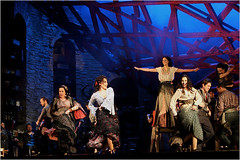
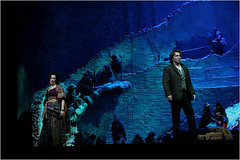
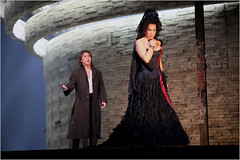
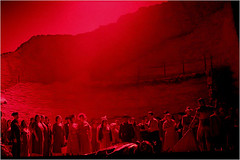
Como é hábito, a 7 de Dezembro, abre a temporada milanesa. Desta feita, Carmen foi a obra escolhida para a abertura do alla Scala.

Baremboim, uma vez mais, dirigiu a première, que contou com Anita Rachvelishvili, como protagonista, Jonas Kaufmann, na pele de Don José, Erwin Schrott, como Escamillo e Adriana Damato, como Micaela.

A encenação e guarda-roupa estiveram a cargo de Emma Dante, tendo os cenários a assinatura de Richard Peduzzi.

Por ora, centremo-nos nas imagens da récita inaugural…
As críticas virão a seu tempo.


quinta-feira, 13 de agosto de 2009

Melhor a emenda que o soneto...


Gheorghiu cancela a sua Carmen (da ópera homónima) - prevista para Dezembro, no Met -, sendo substituída por Garanca.


Mentiria se dissesse que lamento o sucedido...


«(...) Ms. Gheorghiu simply expresses “deep regret” for having to withdraw from this production, which has been highly anticipated partly for the infrequent opportunity to hear a noted soprano sing a touchstone mezzo-soprano role. The mezzo-soprano Elina Garanca, who sang the title role in Rossini’s “Cenerentola” at the Met last season to acclaim, will sing Carmen in place of Ms. Gheorghiu, who will still sing the final two performances for which she was scheduled, on April 28 and May 1. On those dates her Don José will be the tenor Jonas Kaufmann.»


« A spokesman for the Romanian soprano says she is unable to perform the six shows at the Metropolitan Opera in New York for "personal reasons". The production, which is due to open on New Year's Eve, is to be staged by Sir Richard Eyre around Gheorghiu, 43, and her husband, the French tenor Roberto Alagna, 46.

She has rarely played the role of the fiery Spanish gipsy in Georges Bizet's opera, which was written for mezzo-sopranos. The Met's production is due to be broadcast in theatres around the world. The couple have been banned twice by the opera house after their contretemps over previous productions.»